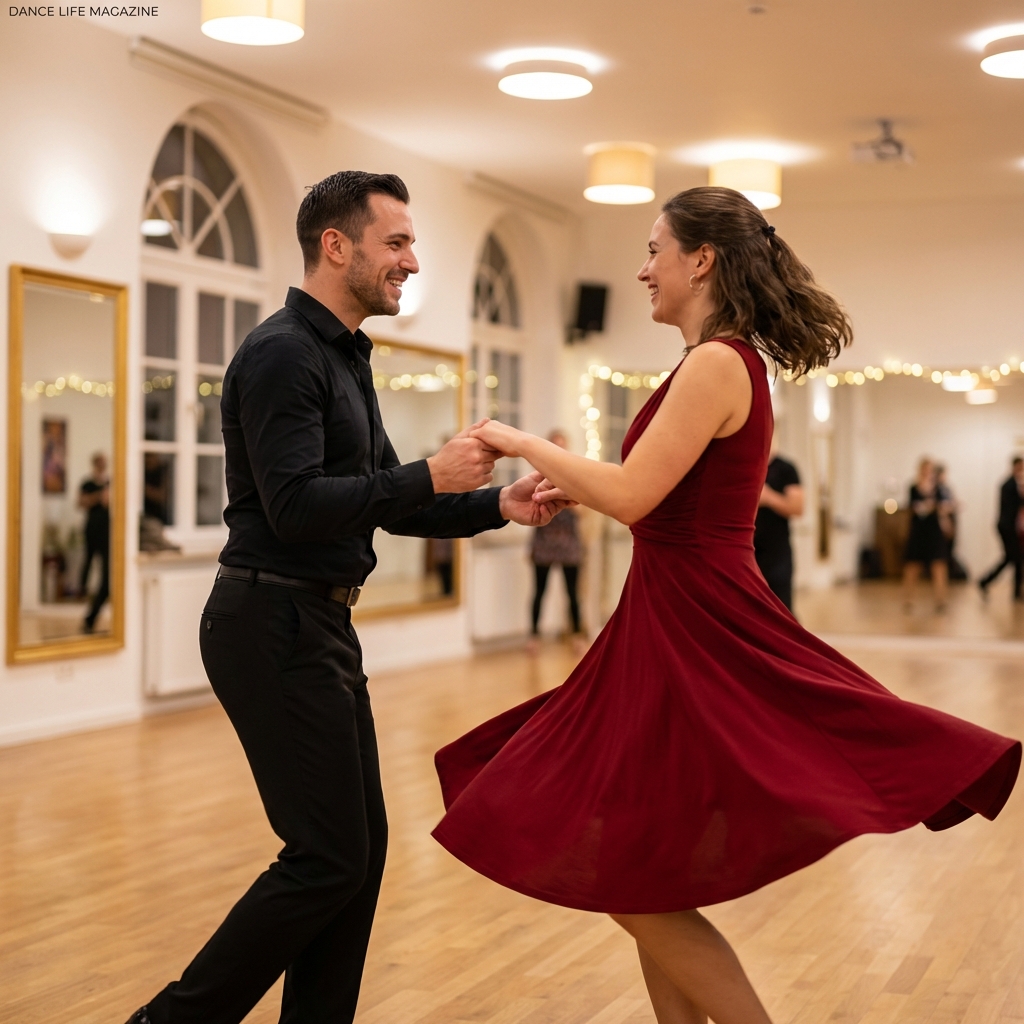
Salsa for beginners: your Montreal guide
Everything you need to know about learning salsa in Montreal, from your first step to finding the perfect dance community.
Quick answer
Can anyone learn salsa? Absolutely. After 19 years of teaching in Montreal, I can tell you this: salsa takes showing up, having fun, and trusting the process, not natural talent. Beginners get comfortable on the dance floor as they practice each week.
If you've ever watched someone dance salsa and thought, "I could never do that," I have good news: you're wrong. And I say that with love.
As a two-time Canadian Latin dance vice-champion and someone who has taught salsa in Montreal for nearly two decades, beginners come in every type: the hesitant wallflower, the overconfident two-stepper, the person whose partner dragged them along. Every one of them can start from step one.
This guide is everything I wish someone had told me when I started dancing. Let's get you on that dance floor. Ready to book? See what to know about salsa classes near you in Montreal. When you want a second Latin dance, try cha cha.
What exactly is salsa?
Salsa is a partner dance that originated in the Caribbean, with heavy influences from Cuban Son, Mambo, and Afro-Cuban rhythms. It's danced to salsa music (obviously), which typically runs at 150-250 beats per minute and features congas, timbales, piano, and brass instruments.
For a beginner, the key fact is this: salsa is a social dance. You dance it with a partner you may have just met, in a club or social setting, improvised in the moment. There's no choreography to memorize for social dancing: just patterns and techniques that you mix and match.
On1 vs On2: which should you learn first?
You'll hear people talk about salsa "On1" (LA style) and "On2" (New York style). The difference is which beat you break on:
- On1 (LA Style): You step forward on beat 1. This is more common in Montreal and easier for beginners to pick up because beat 1 is the most obvious in the music.
- On2 (NY Style): You step on beat 2. This gives a smoother, more grounded feel and is popular in the New York salsa scene.
My recommendation: Start with On1. It's easier to hear the beat, there are more On1 dancers in Montreal to practice with, and you can always learn On2 later. Most intermediate dancers eventually learn both.
The basic salsa step (your foundation)
Every salsa dancer, from total beginner to world champion, uses the same basic step. Salsa is danced in 8-count phrases, but you only step on 6 of those counts.
For Leaders (typically men):
- Step forward with left foot (beat 1)
- Weight shift to right foot (beat 2)
- Step back with left foot (beat 3)
- Pause - weight on left (beat 4)
- Step back with right foot (beat 5)
- Weight shift to left foot (beat 6)
- Step forward with right foot (beat 7)
- Pause - weight on right (beat 8)
For Followers (typically women):
- Step back with right foot (beat 1)
- Weight shift to left foot (beat 2)
- Step forward with right foot (beat 3)
- Pause - weight on right (beat 4)
- Step forward with left foot (beat 5)
- Weight shift to right foot (beat 6)
- Step back with left foot (beat 7)
- Pause - weight on left (beat 8)
Pro tip: The pauses on 4 and 8 matter most. Don't rush through them. This is where salsa gets its characteristic syncopated feel. In my classes, I always tell students: "The pause is not nothing. It's something."
5 Things every salsa beginner should know
1. You Don't Need a Partner to Start
Many people put off salsa lessons for this reason. "I don't have anyone to go with." Good news: you don't need one. In group classes, we rotate partners constantly. You'll dance with everyone in the room. This is actually better for learning because you adapt to different partners rather than developing bad habits with just one person.
2. Rhythm Matters More Than Steps
I'd rather see a beginner doing simple steps perfectly on time than an intermediate dancer attempting advanced moves off-beat. Salsa is music made visible. If you're not dancing to the music, you're just moving around. Spend time listening to salsa music outside of class. Let it become familiar.
3. Cuban Motion Is Not Optional (But It Takes Time)
Cuban motion, that hip movement you see in Latin dancers, comes from proper weight transfer and bent knees, not from consciously shaking your hips. It takes months to develop naturally. Don't force it. Keep your knees soft, transfer your weight fully, and the hip motion will emerge on its own.
4. Connection Is Everything in Partner Dancing
Salsa is a conversation between two bodies. Leaders communicate through frame and subtle hand pressure. Followers respond and add their own styling. Neither is "in charge". It's a collaboration. This is what makes social dancing so addictive once you get it.
5. Consistency Beats Intensity
One class per week, every week, beats four classes in one week followed by a month off. Your body needs time to internalize new movements. Dancing is largely muscle memory, and that memory is built through regular, spaced practice.
Between classes: small habits that speed you up
- Relax your body. Tension is the enemy of good dancing. Keep your shoulders down and breathe.
- Look at your partner, not your feet. Trust that your feet know where to go.
- Practice at home. Even 10 minutes of your basic step to music keeps it fresh between classes.
- Mix group and private. Group classes are great for meeting people and social practice; private lessons let you focus on exactly what you want to fix. You can do both.
What to expect at your first salsa class
Walking into your first salsa class can feel intimidating. Here's exactly what will happen at most beginner salsa classes in Montreal:
- Warm-up (5-10 minutes): Light stretching and maybe some solo footwork to get everyone moving and comfortable.
- Basic steps solo (10-15 minutes): You'll learn the basic step on your own first, without a partner.
- Partner work (20-30 minutes): Now you'll pair up. Partners rotate every few minutes so everyone gets to practice with different people.
- New patterns (15-20 minutes): Once the basic is solid, you'll learn 1-2 new moves, maybe a simple turn or cross-body lead.
- Practice time (5-10 minutes): Free dancing to put it all together with music.
What to wear: Comfortable clothes you can move in. Avoid jeans that restrict hip movement. For shoes, anything with a smooth sole works: avoid running shoes with rubber soles that grip the floor too much. Ladies, low heels or dance sneakers are ideal for beginners.
How long does it take to learn salsa?
This is the question everyone asks. Here's a rough timeline. Everyone moves at their own pace:
| Timeline | What to Expect |
|---|---|
| Week 1-4 | Basic step, finding the beat, basic turns |
| Month 2-3 | Comfortable at socials with core patterns |
| Month 4-6 | Adding styling, musicality, advanced turns |
| 6-12 months | Solid intermediate dancer |
| 1-2 years | Advanced level, personal style emerges |
These timelines assume you're taking one weekly class and attending at least one social per month. Add private lessons and more practice, and you'll progress faster.
Salsa music: what to listen for
You can't dance well to music you don't understand. Here are some songs perfect for beginners to practice with:
- "Vivir Mi Vida" by Marc Anthony, Clear beat, medium tempo
- "La Vida Es Un Carnaval" by Celia Cruz, Classic salsa, great energy
- "Quimbara" by Celia Cruz, Perfect for hearing the clave
- "Tu Con El" by Frank Reyes, Slower tempo, great for practice
- "Llorarás" by Oscar D'León, Classic, steady rhythm
Create a playlist and listen during your commute. Even if you're not dancing, your brain is learning the rhythm patterns.
Why learn salsa in Montreal?
Montreal has a lively Latin dance scene, and that makes it a great city to learn salsa:
- Active social scene: Multiple salsa socials every week across the city
- Cultural diversity: Montreal's multicultural makeup means authentic Latin influences everywhere
- Festival International de Jazz: Summer means outdoor dancing and Latin music festivals
- Quality instruction: Competition-level instruction (including ours!) is available in Montreal
Ready to start your salsa journey?
I want you to remember this: every great salsa dancer was once exactly where you are now. Nervous. Unsure. Wondering if they had any rhythm at all.
The difference between someone who learns to dance and someone who doesn't isn't talent. It's simply showing up. So show up. Take that first class. Let yourself be a beginner.
And if you're in Montreal and want to learn from a team that will meet you exactly where you are, with patience and expertise built over 19 years, we'd love to dance with you.
Start dancing salsa in Montreal
Join our beginner-friendly salsa classes taught in English, French, and Russian.
Alina Litvak, Founder of Quartier Latin Dance Studio
Two-time Canadian Vice-Champion • North American Bronze Medalist • 19 Years Teaching Experience