Going to dance class alone? Here's exactly what happens
Walk in knowing nobody. By the end of the hour, you'll have danced with most of the room.
Quick answer
Should you go to a dance class alone? Yes. In salsa and bachata classes, partners rotate, so you dance with the whole room and nobody stays paired for the hour. You don't need a partner, an opening line, or experience. You need water, smooth-soled shoes and the nerve to walk in once.
Going to dance class alone feels like walking into a party where you know nobody. Then the teacher starts, and you have a plan, a step to learn, and a reason to talk to someone new at every partner change.
If you've been waiting for a friend or a partner to come with you, you can stop waiting. Below: the first 10 minutes step by step, what to say, and what to bring.
Going to dance class alone: the first 10 minutes
- Arrive 10 minutes early. Change shoes, fill your water, find a spot. Early is calmer than rushing in mid-warm-up.
- Tell Alina it's your first class. One sentence is enough.
- Warm up on your own. You learn the step on your own first. No partner yet.
- Learn the basic step. Forward and back for salsa, side to side for bachata. Count out loud if it helps; plenty of people do.
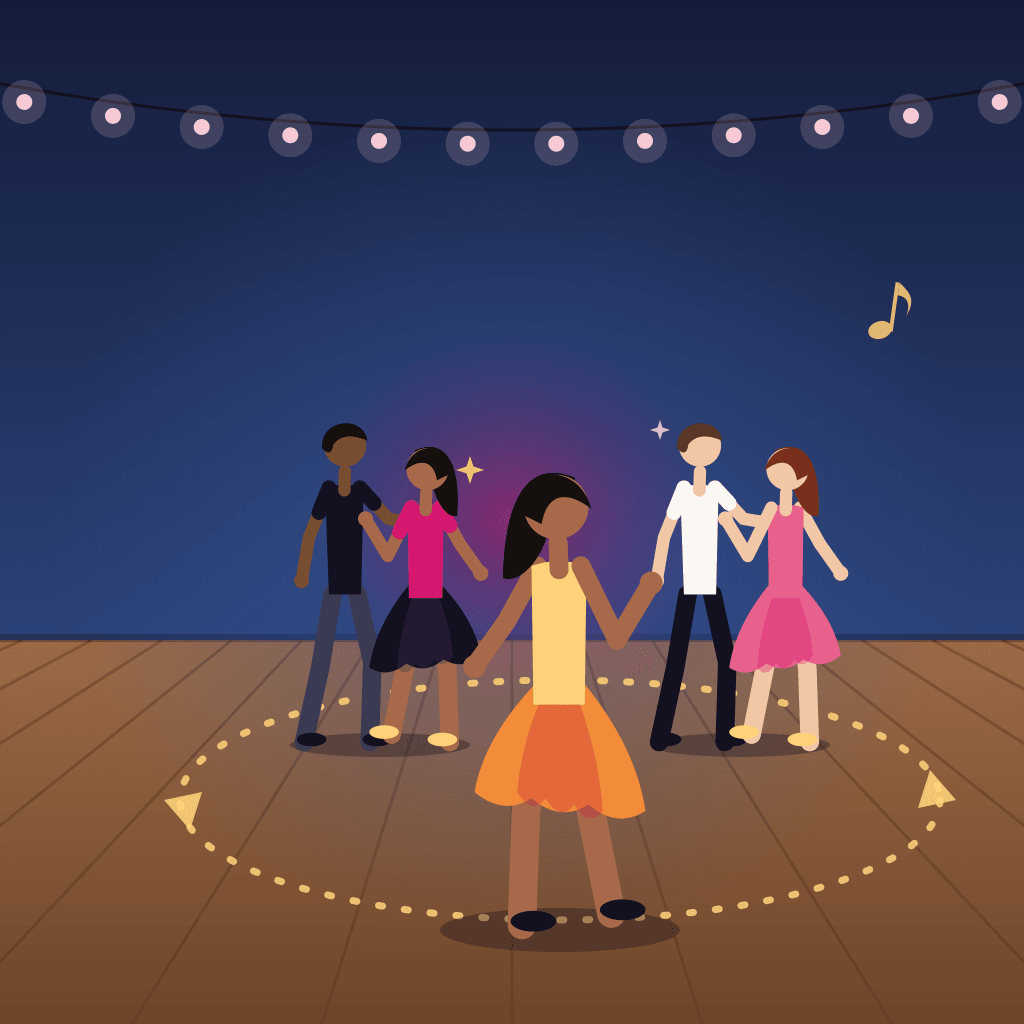
- Then the circle forms. Leaders on one side, followers on the other, facing each other. Now the rotation starts.
Nervous is normal: the structure does the hard part for you, and the first partner change breaks the ice.
Is it weird to go to a dance class alone?
No. It only feels weird in the minute before you open the door.
Four things make the feeling pass almost at once:
- Nobody knows who came with whom. After the first partner change, solo students and couples look exactly the same.
- Everyone is focused on the step. Beginners are busy counting, not looking around to see who is alone.
- The teacher runs the room. You're told where to stand, who to dance with and when to switch. No decisions to make.
- Plenty of people start this way. Moving to a new city, a new job, a friend who cancelled: solo is a normal way in.
The awkward part is real, but it's short. It usually ends with the first "change."
Do you need a partner for salsa or bachata classes?
No. Our salsa and bachata classes in Montreal rotate partners, so you dance with everyone in the room from the first change.
Even couples who arrive together usually rotate. Learning with many partners is how you get good: each person reacts a little differently, so you learn what actually works.
How partner rotation works
- You practise a move with one partner for a short stretch.
- The teacher calls "change." Followers (or leaders) move one spot along the circle.
- You say hi, and go again. Same move, new person.
- Repeat until you've danced with most of the room.
Leaders guide, followers respond, and anyone can learn either role. If you have a preference, tell the teacher at the start.
What if the numbers are uneven?
It happens, and nobody sits out for long: the rotation keeps moving, so you're back in at the next change.
Coming solo? Nervous is normal. We're good at that part.
Free 15-minute call. Tell us your level and we'll point you to the class that starts from step one.
What to say (you need less than you think)
Rotation gives you a reason to talk, so you never need an opening line. These three cover almost every partner change:
- "Hi, I'm Sam." A name and a smile. That's the whole introduction.
- "First class for me." It lowers the pressure for both of you.
- "Want to try that once more?" The best line in any class. Nobody minds a second try.
One more: skip the apologies. One "my mistake" is polite. Ten makes your partner manage your nerves instead of the step. Our dance etiquette guide covers the rest.
Dance class solo vs with a friend
- Solo: you meet more people, and you come at your own pace. Nobody's schedule decides yours.
- With a friend: easier to walk in the first night. But you'll rotate apart anyway, and if they quit, you need a reason to keep going.
Both work. If waiting for a friend has stopped you for months, go alone this once.
Tip: commit to the whole session (usually 8 weeks), not just one night. Names stick after a few weeks of the same faces, and the class starts to feel like yours.
What to bring to dance class
- Water. You'll want it.
- Shoes with a smooth sole or dance shoes. Socks are fine for a first class. Rubber-soled sneakers grip and stick.
- Clothes you can move in. Light layers; you'll warm up fast.
- Mints, as a courtesy to your partners. Partner dancing is close.
Full list: what to wear to a dance class.
If you're a man starting from zero
Men often worry most about coming alone, because leading feels like more responsibility. It's a skill taught step by step, like the rest. See dance classes for men: what the first month looks like.
After class: where solo starts to feel social
The weekly class is where you learn. A social (a night of open dancing) is where you use it. After a few weeks of the same faces, ask a classmate to go with you. It's an easy way to try your first social without walking in alone.
When you're ready, read our salsa beginner's guide for Montreal. New in town and looking for a weekly crowd? See how to meet people in Montreal through a dance class.
Who's at the front of the room
Alina Litvak, two-time Canadian vice-champion, teaches every class herself, so the person who greets you on night one is the one who runs the rotation.
Classes in English, French and Russian, 19 years of beginners, free parking on site.
Questions about going to dance class alone
Is it weird to go to a dance class alone?
No. In a partner dance class with rotation, coming alone is the normal way to start. Partners change throughout the class, so nobody can tell who came with whom after the first song.
Do you need a partner for salsa classes?
No. Salsa classes rotate partners, so you dance with everyone in the room. The same goes for bachata.
Can you learn bachata alone?
You can practise the basic step and timing alone at home, but bachata is a partner dance: leading and following are learned with real partners. A class with rotation gives you many partners in one hour.
What if there are more leaders than followers, or the reverse?
It happens, and nobody sits out for long: the rotation keeps moving, so you're back in at the next change.
What should I bring to my first dance class?
Water, comfortable clothes you can move in, and shoes with a smooth sole (or dance shoes). Socks are fine for a first class. Skip rubber-soled sneakers: they grip the floor.
Walk in alone. Walk out knowing names.
Free 15-minute call. Tell us your level and we'll point you to the right class.
Alina Litvak, Founder of Quartier Latin Dance Studio
Two-time Canadian Vice-Champion • 19 Years Teaching Experience