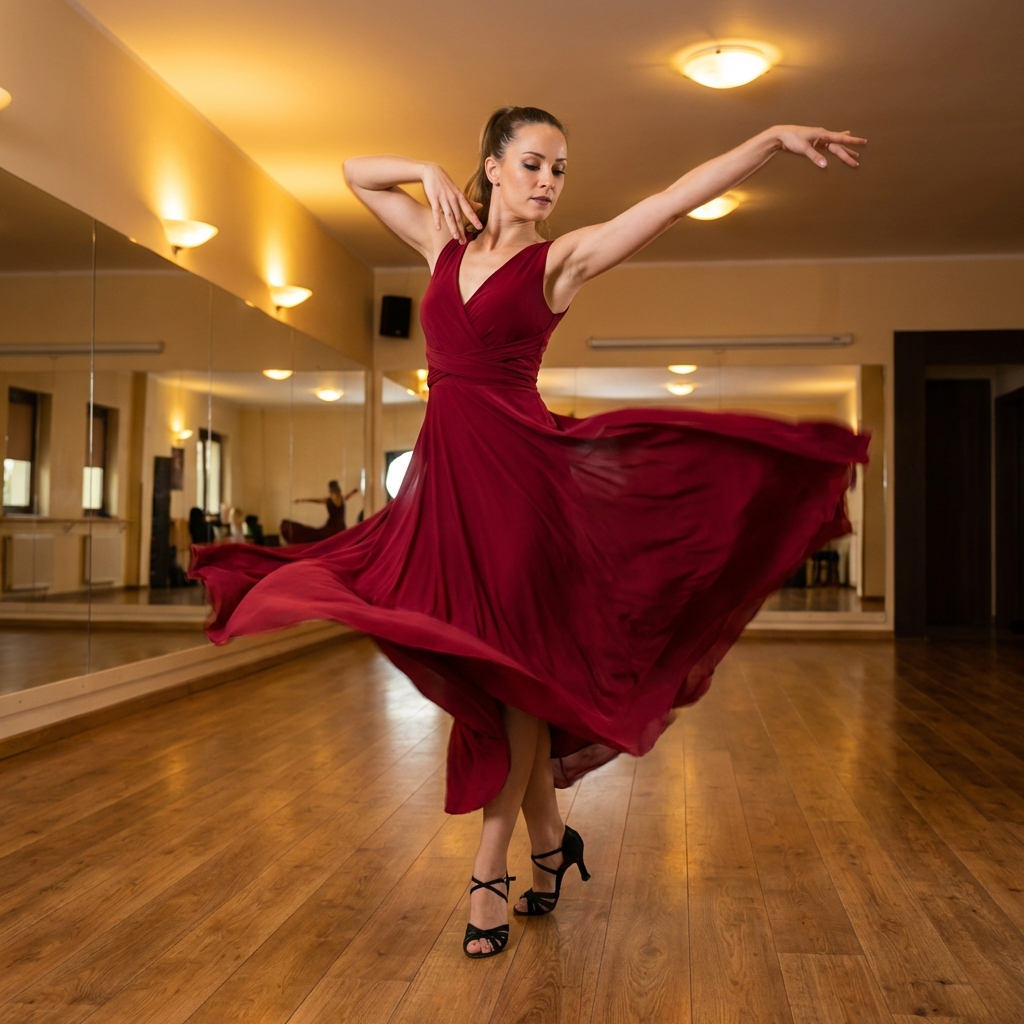
The anatomy of a salsa turn: improving your balance and speed
If I had a dollar for every student who said "I just can't turn"... I'd have a very nice espresso machine by now. After 19 years of teaching, I know this:everyone can turn well. It's not about natural talent. It's about understanding the mechanics.
Today, let's deconstruct the salsa turn from the inside out.
The three pillars of a clean turn
Every successful salsa turn rests on three elements working in harmony:
1. The core foundation
Your turn doesn't start in your feet. It starts in your core. Think of your midsection as the engine of your spin. When I see wobbly turns, the first thing I check is core engagement. You don't need six-pack abs, but you need awareness and activation.
Quick test: Stand on one foot for 10 seconds. If you're wobbling immediately, we need to work on your core stability before adding rotation.
2. The spotting technique
Spotting is the secret weapon of every great turner. Here's the principle: your eyes stay fixed on one point as long as possible, then whip around to find that same point again before your body completes the rotation.
Why does this work? It prevents dizziness and gives your brain a fixed reference point. Without spotting, your inner ear gets confused, and you'll feel off-balance even when your technique is correct.
3. The weight transfer
The magic happens in that split second when you transfer weight to your turning foot. Too slow, and you drag through the turn. Too fast, and you throw yourself off-balance. The transfer should be decisive but controlled.
Common turn mistakes (and how to fix them)
Looking down
When you look at your feet, you shift your center of gravity forward. Now you're literally fighting gravity every time you turn. Keep your chin parallel to the floor.
Wide arms
Arms away from your body act like brakes on a spin. For faster turns, bring your arms closer to your core. Think "compact," not "starfish."
Flat feet
You should be turning on the ball of your foot, not your entire sole. A flat foot creates friction and makes smooth rotation impossible.
Holding your breath
Yes, really. Tension from breath-holding travels to your shoulders and neck, throwing off your alignment. Breathe through your turns.
The progressive practice method
In my private lessons, I use a four-stage progression for turn mastery:
- Stage 1: Stationary pivots - Practice the rotation without moving through space
- Stage 2: Quarter turns - Build confidence with 90-degree rotations
- Stage 3: Full single turns - Complete 360-degree rotations at slow tempo
- Stage 4: Speed and multiples - Increase tempo and add double/triple turns
Most students want to jump to Stage 4 immediately. But rushing through foundations means building habits you'll have to unlearn later. Trust the process.
The mental game
Here's something most instructors don't tell you: hesitation destroys turns. When you start a turn with doubt, your body tenses up and fights the movement.
Commit to the turn before you start it. Even if you wobble, a committed wobble is better than a hesitant fall. Confidence in movement often becomes confidence in execution.
Practice exercises you can do at home
The Wall Spot: Stand facing a wall with a small mark at eye level. Practice spotting that mark through quarter turns, then half turns, then full rotations.
The One-Foot Balance: Stand on one foot (your turning foot) for progressively longer periods. Add arm movements once you can hold 30 seconds confidently.
The Slow-Motion Turn: Do your turns at half-speed without music. Feel every phase of the movement. What's stable? What wobbles? Awareness is the first step to improvement.
When to seek professional help
Group classes are great for learning patterns, but turns benefit enormously from individual attention. In a private session, I can see exactly where your specific turn breaks down and give you targeted corrections.
If you've been working on turns for months without improvement, it's usually a small mechanical issue that an experienced eye can spot in minutes.
The bottom line
A beautiful turn is a controlled spin, not a fast one. Master the fundamentals of core engagement, spotting, and weight transfer, and the speed will come naturally.
And remember: every professional dancer you admire once wobbled through their first turns. The difference is they kept practicing. If you are newer to dance, see the common beginner dance mistakes that slow most students down, how a fun, party-style way of learning keeps practice enjoyable, and how private coaching helps with two left feet.
Want to perfect your turns?
Call for a free 15-minute chat about private lessons focused on turn technique.