Why salsa is Montreal's favourite dance, and why you will love it
From beginners to seasoned social dancers, salsa is the dance people ask about first. Here is why it hooks them.
Quick answer
Why is salsa so popular in Montreal? Three reasons: a thriving Latin community brings real cultural energy, the social scene gives you somewhere to practice almost every night, and the dance is easy to start and has no ceiling.
Walk into any social dance event in Montreal on a Friday or Saturday night, and you will see salsa everywhere. It is the partner dance you meet most often on Montreal dance floors, and it fits the city well.
Montreal's Latin heritage creates the perfect environment
Montreal has a large Latin American community. Immigrants from Colombia, Cuba, Mexico, Venezuela, and the Dominican Republic have brought their music, their dance traditions, and their social culture to the city over the past several decades. The scene grew from the community itself.
The result: live salsa bands play regularly at Montreal venues. Latin restaurants feature dance floors. Caribbean food festivals include salsa demonstrations. The music is everywhere, and where the music goes, the dance follows. For someone searching for salsa classes near them in Montreal, the cultural infrastructure is already in place to support their learning journey far beyond the classroom.
The social scene keeps you dancing
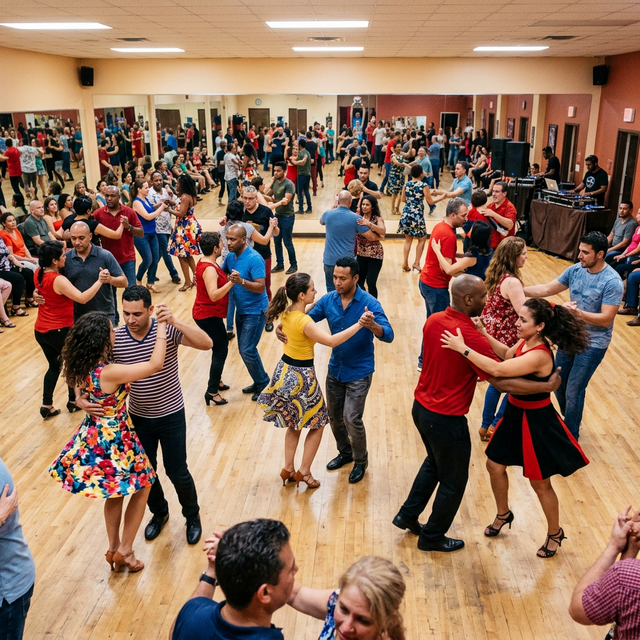
The single biggest reason salsa retains students better than other dances is the social scene. In Montreal, you can dance salsa socially almost every night of the week:
- Regular salsa socials at studios and dedicated venues
- Latin nights at bars and clubs across the city
- Outdoor summer festivals with live music and dancing
- Practice parties specifically designed for students and beginners
This matters because practice is what turns a student into a dancer. You can take classes for years, but without social dancing (real, unscripted interaction with real partners on a real dance floor) progression plateaus. Montreal's salsa infrastructure ensures that students always have somewhere to practice, someone to dance with, and a community that welcomes them.
Easy to start, impossible to master
Salsa has the ideal learning curve for adult beginners. The basic step is simple. You can learn it in your first class. A few turn patterns later, you're ready for a social dance. That early success is addicting and keeps people coming back.
But salsa's depth is virtually infinite. After years of dancing, experienced salseros are still discovering new combinations, musicality techniques, body movement variations, and styling elements. The dance evolves constantly, influenced by new music, regional innovations, and individual creativity.
This combination (easy entry, endless ceiling) is rare in partner dancing. Waltz and foxtrot have a higher initial barrier. Bachata has a lower ceiling. Tango is challenging from day one. Salsa uniquely rewards both the first-time beginner and the 20-year veteran.
The music is irresistible
Salsa music makes you move. The clave rhythm, the layered percussion, the horn sections, the call-and-response vocals, every layer pulls your body in. Unlike some dance forms where the music is merely background, salsa music is the conversation. Dancers interpret it, respond to it, and express it through their movement.
Montreal's multicultural music scene means you'll hear everything from classic Cuban son to modern Colombian salsa dura to Dominican salsa romántica. This musical diversity keeps the dance fresh and gives every dancer room to develop their own style and musical preferences.
The community factor
Perhaps the most underrated reason for salsa's popularity: the people. Montreal's salsa community is welcoming. There's an unwritten code that experienced dancers accept invitations from beginners, that nobody judges mistakes on the social floor, and that everyone helps newcomers feel included.
Not every dance scene works this way. Some can feel cliquish. Montreal's salsa scene stays open, partly because the Latin tradition puts celebration and togetherness ahead of perfection. To see how dance fits into the city more widely, read our guide to Montreal dance culture.
Ready to join Montreal's salsa community? Our salsa classes welcome complete beginners. No partner needed. Classes in English, French and Russian. Call for a free 15-minute chat.
Join Montreal's salsa community
Start with a free 15-minute call.
Alina Litvak, Founder of Quartier Latin Dance Studio
Two-time Canadian Vice-Champion • 19 Years Teaching Experience