Hip movement in Latin dance: the one thing beginners overthink
Stop trying to move your hips. Seriously. The hips move themselves.
Quick answer
How do you get hip movement in Latin dance? You don't "do" hip movement: you allow it. Latin hip action is a result of proper weight transfer, not a separate movement you add. When you fully straighten the standing leg and shift your weight completely from one foot to the other, the hip settles naturally to the side. The most common beginner mistake is pushing the hips on purpose, which looks forced.
Almost every Latin dance beginner wonders the same thing, even if they're too embarrassed to ask: "How do I move my hips like that?"
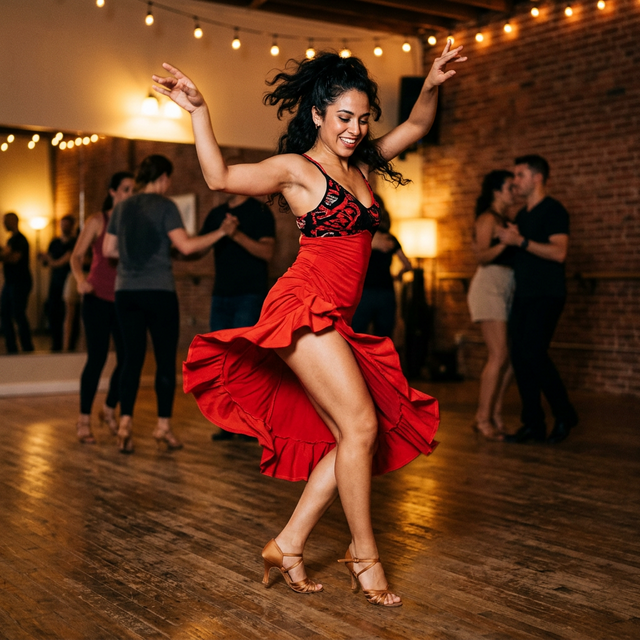
The answer surprises people: you don't. You don't move your hips. Your hips move themselves, when you do everything else correctly. Hip action in Latin dance is an output, not an input. It's the result of proper technique, not a technique unto itself. Once you get this distinction, Latin movement gets easier.
The mechanics: why hips move in Latin Dance
The biomechanics, in simple terms:
- You step onto one foot.
- You transfer your weight fully onto that foot. (This is the part most beginners skip. They keep weight distributed between both feet.)
- You straighten the standing leg. (Not locked, but straight. This is the key.)
- When the standing leg straightens, the hip on that side naturally settles to the side.
- When you step onto the other foot and straighten that leg, the opposite hip settles.
The alternating straightening of legs creates the characteristic side-to-side hip motion that defines Latin dance. You're not pushing your hips. You're letting gravity and anatomy do the work.
The three biggest hip movement mistakes
Mistake 1: forcing the movement
When beginners try to "do hip movement," they typically push their pelvis side to side using their lower back muscles. This looks forced, feels uncomfortable, and can actually cause lower back pain over time. Natural Latin hip action doesn't come from the lower back. It comes from the legs. Fix the leg action, and the hips follow automatically.
Mistake 2: keeping both knees bent
Many beginners keep both knees slightly bent at all times, thinking it looks more "dance-like." In reality, this prevents hip settlement entirely. For the hip to move to the side, the standing leg needs to straighten. Think of it as a seesaw, one leg straight, one leg bent, then they switch.
Mistake 3: not completing the weight transfer
If you keep weight on both feet (even 60/40), you can't achieve full hip settlement. Latin dance requires a committed weight transfer: 100% of your weight on one foot at a time. This feels scary for beginners who want the security of having both feet grounded, but it's essential for natural hip action.
How we teach hip action
After 19 years of teaching in Montreal, this is the progression we use for students who feel stiff:
Step 1: the wall exercise
Stand facing a wall with your hands flat against it for support. Step side to side slowly, fully straightening the standing leg each time. The wall takes away balance anxiety, so you can focus on the leg-hip connection.
Step 2: the mirror check
Practice the same side-to-side stepping in front of a mirror. Watch your hips, not your feet. You'll see the movement happening even if you can't fully feel it yet. Seeing it confirms your body is doing something you can't feel yet.
Step 3: add the "settle"
Once the basic weight transfer is comfortable, add a deliberate pause at the top of each step, a moment where you let the hip fully settle before stepping again. This "settle" is what gives Latin dance its sensual quality. It's not about speed; it's about completion. Each step has a beginning (the transfer), a middle (the arrival), and an end (the settle).
Step 4: add music
Start with slow bachata. It gives you the most time between steps to focus on hip settlement. As the movement becomes more natural, progress to cha cha (faster, more rhythmic hip action) and eventually salsa (continuous, flowing hip movement).
How long until it feels natural?
It varies. Everyone's body is different: some people have natural hip mobility, while others need more time to develop the coordination. Neither starting point is better or worse. For related reading, see our posts on dance posture for desk workers, body positivity on the dance floor and common beginner mistakes.
The most important thing is patience. Your hips have been stationary for years (or decades). They need time to remember how to move.
Find your Latin movement
Private lessons focus on your own body mechanics. Ask about them on a free 15-minute call.
Alina Litvak, Founder of Quartier Latin Dance Studio
Two-time Canadian Vice-Champion • 19 Years Teaching Experience
- Tags:
- Technique
- Latin Dance