Learning dance from a teacher vs. YouTube
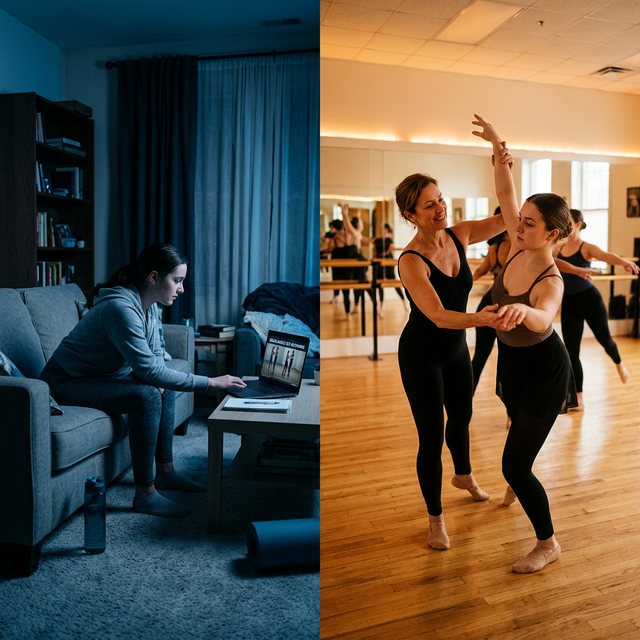
YouTube teaches you moves. A teacher teaches you to dance.
Quick answer
Can you learn to dance from YouTube? You can learn dance moves from YouTube, but you cannot learn to dance from YouTube. The critical difference: dance is a physical skill that requires real-time correction, partner interaction, and feedback that only an in-person teacher can provide. Use YouTube between classes, not instead of them.
Yes, I teach at Quartier Latin Dance Studio, so I'm biased toward teachers. After 19 years of teaching, the difference is clear between students who learn in a studio and students who learn from screens, and the gap is big.
Here is where each one wins.
What YouTube does well
- Exposure. YouTube is great for discovering dance styles, watching inspiration, and understanding what's possible. Before you take a class, it shows you which style excites you.
- Supplementary practice. If you're already taking lessons, YouTube videos let you review material between classes. Seeing a move demonstrated from multiple angles reinforces what you learned in person.
- Accessibility. YouTube is free and available 24/7. For people in areas without dance studios (not Montreal, we have plenty), it's often the only option.
- Solo preparation. Footwork patterns, body isolations, and rhythm exercises can be practiced alone at home using video tutorials.
What YouTube cannot do
1. Correct your mistakes
This is the biggest limitation, and it's fundamental. When you dance in front of a screen, nobody tells you that your frame is collapsing, your weight is on the wrong foot, your timing is consistently off by half a beat, or your lead is unclear. You practice the mistake. You repeat the mistake. The mistake becomes muscle memory. And then, when you finally take a real class, your teacher has to spend weeks un-teaching the habits you've cemented.
At Quartier Latin, I can usually spot a YouTube-trained dancer quickly: impressive-looking moves sitting on shaky technique. Rebuilding foundations after months of self-taught habits is much harder than building them right the first time.
2. Teach partner connection
Partner dancing is a physical conversation. You cannot learn a conversation by talking to yourself. The lead-follow dynamic (the subtle weight shifts, the frame tension, the spatial awareness, the real-time adaptation to another person's movement) is impossible to simulate with a video. This is non-negotiable: if you want to partner dance, you need a partner and a teacher who can guide the interaction.
3. Provide progressive curriculum
YouTube teaches moves in isolation. A good teacher teaches a curriculum, a structured progression from fundamental to advanced concepts, where each skill builds on the previous one. Without this structure, YouTube learners often know advanced moves but lack basic skills, creating a lopsided skill set that's impressive on TikTok but falls apart on the social dance floor.
4. Adapt to your body
Every body is different. The way I show a turn might not work for someone with different proportions, flexibility, or physical limitations. A good teacher adapts their instruction to your specific body, adjusting hand positions, modifying footwork, suggesting alternatives. YouTube delivers one-size-fits-all instruction that assumes every viewer has the same body and abilities. Your goals matter too, and competitive coaching and social dance prep call for different approaches.
5. Build community
Dance is a social activity. The community you build in a studio (the friendships, the practice partners, the social events, the shared progress) is a huge part of what makes dance sustainable and rewarding long-term. YouTube is solitary, and it's easier to quit a hobby when nobody expects you at class.
The smart approach: YouTube + teacher
The best combination is YouTube and a teacher together:
- Take classes for instruction. Learn technique, partner skills, and musical interpretation from a qualified instructor.
- Use YouTube for review. After learning a concept in class, watch videos that cover the same material to reinforce it visually.
- Practice footwork at home. YouTube tutorials for solo footwork drills are excellent between-class practice.
- Watch performances for inspiration. Professional dance videos on YouTube show you what's possible and keep your motivation high.
- Never learn new partner patterns from YouTube alone. Always get the fundamentals from a teacher first.
What bad habits cost you
A YouTube learner who practices for six months with flawed technique then has to un-learn those habits in class. Starting with proper instruction at Quartier Latin means you build it right once.
Build the right foundation
Start with proper technique from day one, with no bad habits to unlearn later. Call for a free 15-minute chat about the right first step.
Alina Litvak, Founder of Quartier Latin Dance Studio
Two-time Canadian Vice-Champion • 19 Years Teaching Experience