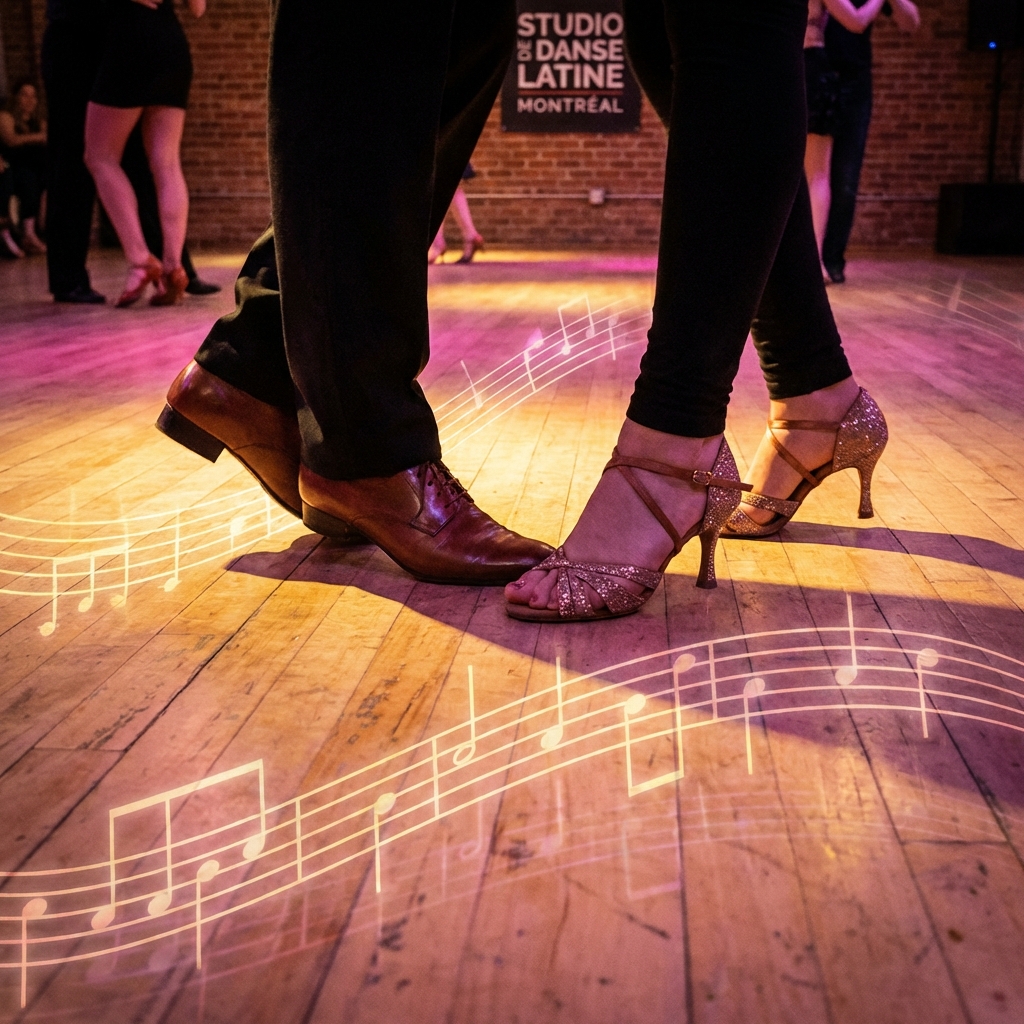
Salsa timing demystified: finding the "1" and the "8" every time
"I can't hear the beat." This is the most common frustration I hear from beginner salsa dancers. And it's almost always a misconception, not about your ears, but about what you're listening for.
After 19 years of teaching, I've developed a systematic approach to salsa timing that works for everyone, even people convinced they're "rhythmically challenged."
Understanding salsa music structure
The 8-count phrase
Salsa music is organized in 8-beat phrases. Everything (the melody, the rhythm section, the breaks) resets every 8 counts. This is your roadmap.
The basic step takes 8 beats to complete:
- Beats 1-2-3: Three steps in one direction
- Beat 4: Pause (hold/tap)
- Beats 5-6-7: Three steps in the other direction
- Beat 8: Pause (hold/tap)
This 8-count structure is the heartbeat of salsa. Once you internalize it, everything else clicks into place.
Why finding "1" matters
The "1" is the beginning of the phrase. When you step on the 1, you're synchronized with the music's natural structure. Miss the 1, and your dancing feels "off", even if your steps are technically correct.
Want to learn more about the two main timing systems? Check out our guide to On1 vs. On2 salsa.
How to find the "1"
Method 1: listen for the clave
The clave is a rhythmic pattern that runs through most salsa music: two wooden sticks creating a distinctive "click click... click click click" pattern. The clave almost always lands on the 1.
Train yourself to hear it: play salsa music and tap along with just the clave. Once you can identify it, you'll never lose the 1.
Method 2: listen for the tumbao
The tumbao is the bass pattern in salsa. It typically accents beats 4 and 8: the "and" before the 1. When you hear that bass note, you know the 1 is coming next.
Method 3: feel the phrase reset
Every 8 counts, something in the music resets: a melodic phrase ends, drums accent, horns punch. This "reset" feeling almost always happens on or around the 1. Learn to feel when the music "breathes."
Method 4: count backward
If you've lost the 1, don't panic. Listen for the 4 and 8, the stronger accents in salsa. Count backward: "8, 7, 6, 5, 4, 3, 2, 1." You'll land on the 1.
Common timing mistakes
Rushing the pause
The pauses on 4 and 8 are just as important as the steps. Beginners often rush through them, stepping on 4 instead of holding. This throws off everything that follows.
Fix: Exaggerate the pause. Make it deliberate. Think "step-step-step-WAIT" rather than "step-step-step-step."
Dancing too fast
Fast salsa songs are exciting but challenging. When you can't keep up, you start skipping beats or cramming extra steps in.
Fix: Practice with slower songs until the timing is automatic. Speed comes naturally once the pattern is ingrained.
Ignoring the music
Some dancers focus so hard on the steps that they forget to listen. They're dancing to an internal count, not the actual music.
Fix: Practice dancing to music without counting. Let the music guide you. If you lose the beat, stop, find the 1, and restart.
Training exercises
Exercise 1: just listen
Before dancing, spend 10 minutes just listening to salsa. Don't move. Count the 8s. Clap on the 1. Do this daily for a week, and you'll transform your timing.
Exercise 2: dance the pause
Practice the basic step with exaggerated pauses. On beat 4 and 8, freeze completely for a full beat. This trains your body to respect the timing structure.
Exercise 3: switch songs mid-dance
Create a playlist with different salsa songs. When one ends and another begins, find the 1 of the new song as quickly as possible. This simulates real social dancing conditions.
Exercise 4: dance with a metronome
Set a metronome to a slow salsa tempo (around 100 BPM). Practice stepping precisely on the beat. This develops muscle memory for accurate timing.
Advanced timing concepts
Playing with the beat
Once you can consistently hit the 1, you can start playing with timing: dancing slightly ahead or behind the beat for stylistic effect. But this only works if your foundation is solid.
Musicality
Beyond finding the beat, advanced dancers interpret the music: accenting horn hits, following melodic phrases, responding to breaks. This is where salsa becomes artistic expression.
Want to develop more advanced turn technique? Read our guide to improving your salsa turns.
The quick start method
If you're stepping onto the social floor tonight and need to find the 1 immediately:
- Stand still and listen for 8 counts
- Nod your head on what feels like the heavy beat
- Confirm you're hitting the 1 by listening for the phrase reset
- Start your basic step on the next 1
- If you lose it, stop, listen, and restart
There's no shame in pausing to find the beat. Better to wait 4 counts than dance 4 measures off-time.
When to get help
Some timing challenges benefit from one-on-one instruction. If you've practiced these techniques and still struggle, consider private lessons. I can identify exactly where your timing breaks down and give you personalized exercises to fix it. If you are new to salsa, start with the salsa beginners guide for Montreal and try these rhythm training exercises for beginners.
Ready to master salsa timing?
Let's work on your timing together, whether in a group class or private session. Available in French, English, and Russian.