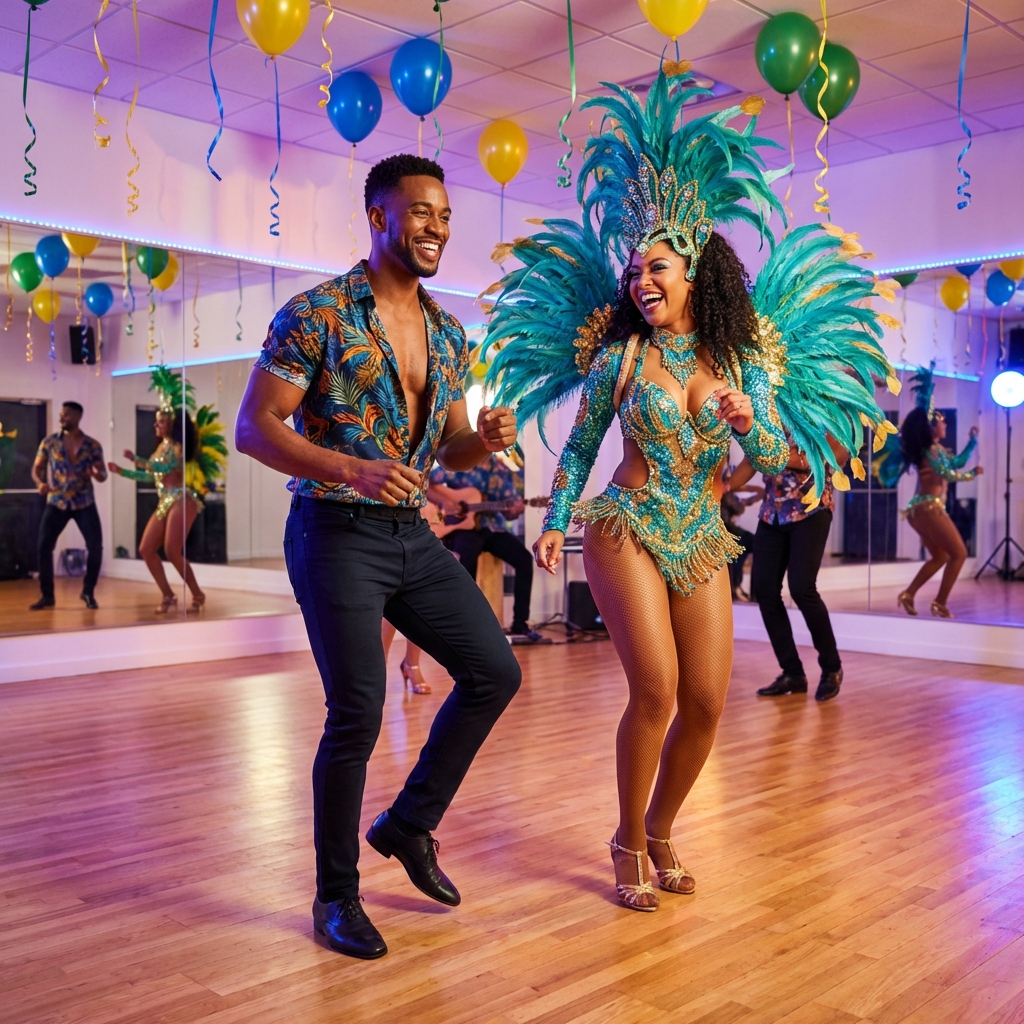
Samba essentials: bring Brazilian energy to your dancing
Master the dance of Carnival and discover why samba's infectious energy makes it impossible to stand still.
Quick answer
What is samba? Samba is Brazil's national dance, characterized by its bouncing action, rolling hip movement, and carnival energy. Ballroom samba is danced to 2/4 time music at 48 to 56 BPM and features the distinctive "samba bounce" that makes dancers appear to float across the floor.
Samba is pure joy in physical form. It's the dance of Rio's Carnival, of celebration, of letting go and moving with abandon. Rooted in Afro-Brazilian tradition and refined through decades of ballroom innovation, samba has become one of the five International Latin competition dances, and one of the most exciting dances to learn.
The ballroom samba we teach in Montreal differs from street samba, but it captures that same irresistible energy. After 19 years of teaching, samba remains one of the dances that transforms students most dramatically: there's something about the bounce that just makes people happy.
Understanding the samba bounce
The key to samba is the "bounce": a rhythmic flex and straighten of the knees that creates a bouncing appearance without actually jumping. Think of it like riding a wave with your body. Without the bounce, you're just stepping to Brazilian music. With it, you're dancing samba.
The bounce originates from three areas working together:
- Ankles: The primary spring mechanism. Your ankles flex and extend to create the vertical motion. Practice by pressing into and releasing from the balls of your feet.
- Knees: They flex slightly on the downbeat and straighten on the upbeat. A subtle flex is all you need. Avoid over-bending.
- Core and pelvis: Your core stays engaged to keep your upper body stable while the pelvis tilts naturally, producing the characteristic hip rolling.
A helpful visualization: imagine you're bouncing a basketball with your body. Down, up, down, up: smooth, continuous, never stopping. The bounce should feel effortless and perpetual, like a heartbeat.
The basic step
Every figure in samba builds from the basic step. The timing is 1-a-2, 3-a-4, with the "a" counts creating the syncopation that gives samba its groove.
Natural Basic:
- Step right foot forward (count 1), with knee bend, bounce begins
- Close left to right with part weight (count "a"), ball of foot only
- Replace weight to right foot (count 2), straighten slightly
- Step left foot back (count 3), bounce continues
- Close right to left with part weight (count "a"), ball of foot only
- Replace weight to left foot (count 4), straighten slightly
The critical detail: on the "a" count, you never fully transfer weight to the closing foot. Think of it as a tap with roughly 25% of your weight before rocking back. This creates the rolling quality that makes samba unmistakable.
Essential figures beyond the basic
Once the basic and bounce feel natural, explore these key figures:
- Whisks: Side-to-side movements where one foot crosses behind the other. They travel across the floor with a sweeping quality and use the same 1-a-2 timing.
- Samba walks: Progressive steps forward or backward with delayed hip action and strong bounce. Each step rolls through the foot: toe, ball, flat.
- Botafogos: Named after the famous Rio neighbourhood, these crisscross travelling steps alternate between crossing in front and stepping to the side. Visually dynamic and recognizable.
- Voltas: Quick travelling steps where one foot consistently crosses in front of or behind the other, creating a spiralling motion. Fast, flashy, and a hallmark of intermediate samba.
Common mistakes
Bouncing from the shoulders. The bounce comes from ankles and knees, not the upper body. Fix: practice while holding a glass of water: if it spills, you're bouncing too much up top.
Flat feet. Samba lives on the balls of your feet. Staying flat-footed kills the bounce. Think of your heels as springs: they touch down momentarily but never settle.
Forcing hip movement. The hips move as a result of the knee and ankle action, not as a separate effort. If your bounce mechanics are correct, the hips roll on their own.
Taking bigger steps when music speeds up. The opposite is true: the faster the music, the smaller and more compact your steps should be.
Music for practice
Samba runs at 48 to 56 bars per minute. Start on the slower end and work up:
- "Mas Que Nada" by Sergio Mendes, perfect tempo for beginners
- "Magalenha" by Sergio Mendes, great for whisks and botafogos
- "Brazil (Aquarela do Brasil)": classic carnival feel
- "Samba de Janeiro" by Bellini, modern party samba with explosive energy
Tip: before you dance to a track, listen to it first. Find the pulse, tap along, then add movement. The body follows what the ear understands. Related guides cover how Latin hip movement works, the fast jive and the flowing waltz.
Ready to feel the rhythm? Our samba lessons start from zero. No partner needed, no experience required. Call for a free 15-minute chat. Classes available in English, French, and Russian.
Feel the rhythm of Brazil
Learn samba with a two-time Quebec champion.
Alina Litvak, Founder of Quartier Latin Dance Studio
Two-time Canadian Vice-Champion • 19 Years Teaching Experience