How to practice dance at home (even without a partner)
Your living room is a dance studio if you use it right.
Quick answer
How do you practice partner dance without a partner? Focus on solo elements: footwork patterns, timing and musicality (dancing to music alone), body isolations, balance exercises, and movement quality. Most of what makes a good social dancer can be practiced without a partner: the footwork, rhythm and body control that form your dance foundation.
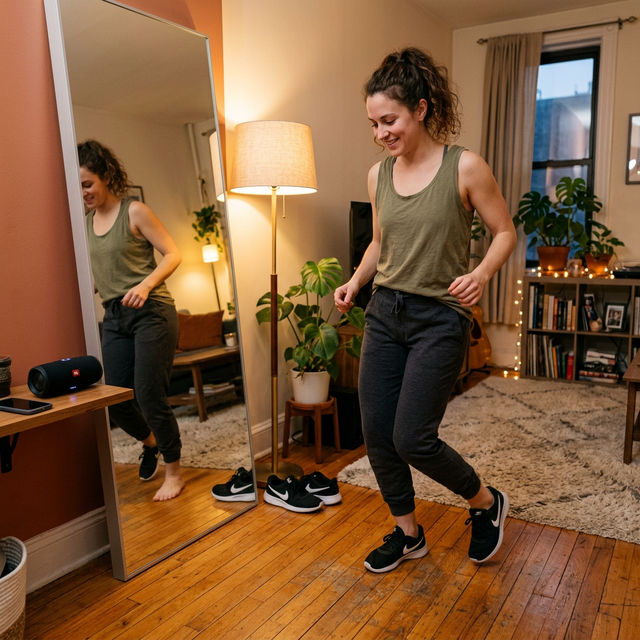
Wondering how to improve faster without a partner at home? You don't need one. Most of what makes a good social dancer can be practiced alone, in your living room, in your socks, with a Bluetooth speaker and 15 minutes of focus.
What you can practice solo
Most of your dance quality comes from individual skills: footwork, timing, balance, body movement and musicality. Partner-specific skills (lead/follow connection, spatial navigation, partner adaptation) are the smaller part. So solo practice covers a lot.
The daily 15-minute solo routine
Minutes 1-3: warm-up body isolations
Stand in front of a mirror (if available) and isolate each body part:
- Head: side to side, forward and back, circles
- Shoulders: up and down, rolls forward and back, individual shoulder pops
- Chest: forward and back, side to side, circles
- Hips: side to side, circles, figure eights
Do this to music: any Latin music will work. The goal is to wake up each body part independently, which is the foundation of good body movement in Latin dance.
Minutes 3-8: footwork practice
This is the core of your solo practice. Put on a song in the style you're learning and practice:
- Basic step on rhythm. The single most valuable practice you can do. Repeat your basic step for a full song, staying perfectly on beat. This builds the automatic timing that frees your brain for everything else during social dancing.
- Direction changes. Practice your basic going forward, backward, to the left, to the right. This builds spatial awareness and versatility.
- Turn practice. Spot turns (looking at a fixed point), cross-body turns, and natural turns. Focus on balance and finishing each turn cleanly on beat.
- Footwork patterns. If you've learned specific footwork combinations in class, run through them repeatedly until they're memorized.
Minutes 8-12: musical interpretation
Put on a song and just dance: no specific patterns, no counting. Let your body respond to the music intuitively. Change your movement when the music changes. Slow down for quiet passages. Accelerate for energetic ones. Add body movement to melodic phrases. Hit accents with sharp movements. This is where you develop the musicality that separates mechanical dancers from magnetic ones.
Minutes 12-15: strength and balance
- Single-leg balance: Stand on one foot for 30 seconds. Then the other. Then with eyes closed. This trains the proprioception essential for partner dancing.
- Relevé holds: Rise onto your toes and hold for 15 seconds. This builds the calf strength needed for smooth, controlled movement.
- Slow weight transfers: Step from one foot to the other as slowly as possible, focusing on smooth control. The slower you go, the harder (and more beneficial) it is.
Advanced solo practice techniques
Shadow dancing
Dance with an imaginary partner. Leaders: practice leading your imaginary partner through moves, maintaining frame position, and executing patterns. Followers: practice your response to imagined leads, maintaining your own balance and styling. It sounds silly, and it works.
Video self-review
Record yourself dancing to a full song. Watch it back. You'll immediately see things you can't feel while dancing: dropped arms, inconsistent timing, posture collapse, awkward transitions. Done weekly, it shows you what to fix next.
Tempo variation
Practice your basic step at three different speeds: slower than normal (builds control), normal tempo (builds consistency), and faster than normal (builds adaptability). The ability to dance at any tempo (not just the one you're comfortable with) is what makes you versatile on the social floor.
What you can't practice alone
Some things do need a partner:
- Lead-follow connection: the physical conversation with a partner
- Frame maintenance under pressure: holding your position while someone else pushes and pulls
- Adaptation: responding to a partner whose style differs from yours
- Spatial awareness with another body: navigating the floor around someone
These skills are practiced in class and at social events. Your solo practice at home handles the rest. If you want to know what a teacher adds beyond video, read how learning from a teacher compares with YouTube, and if a partner wants to join you, see how to practice dancing at home as a couple.
The consistency secret
Short, frequent practice works better than one long session: 15 minutes five days a week beats a two-hour marathon once a week. Put on two songs before your morning shower. Practice footwork while your coffee brews. Dance in your kitchen while dinner cooks. Fold it into your routine and it becomes a habit.
Learn the skills, then practice at home
Group classes give you the foundation, then your living room becomes your practice studio.
Alina Litvak, Founder of Quartier Latin Dance Studio
Two-time Canadian Vice-Champion • 19 Years Teaching Experience
- Tags:
- Practice
- Self-Study