Why bachata is the easiest partner dance to learn first
If you can count to four, you can dance bachata. Seriously.
Quick answer
Is bachata really the easiest dance to learn? For most adults, yes. Bachata has a simple 4-count basic step (side-side-side-tap), slow music that gives you time to think, and a close partner connection that naturally guides you. Most beginners can dance a basic bachata socially within one or two lessons.
Every week, someone walks into Quartier Latin Dance Studio and asks me the same question: "I've never danced before, which dance should I start with?" My answer, almost without exception, is bachata.
It's not because bachata is my favourite dance (though I do love it). It's because bachata gives beginners the fastest path from "I have no idea what I'm doing" to "I'm actually dancing and it feels amazing."
The four reasons bachata wins for beginners
1. The simplest basic step in partner dance
Every partner dance has a "basic step", the foundational pattern you build everything else on. Compare bachata's:
- Bachata: Step left, step left, step left, tap. Step right, step right, step right, tap. That's it. You're dancing.
- Salsa: A 6-count pattern within an 8-count musical phrase, with a "break step" that confuses most beginners for the first several weeks.
- Waltz: A box step in 3/4 time, which feels unfamiliar because virtually no popular music uses 3/4 time.
- Tango: Walking with dramatic intention, weight changes, and pauses, deceptively complex despite looking simple.
Notice the pattern? Bachata is the only major partner dance where the basic step is literally walking sideways. The simplicity is the feature. A simple foundation means your brain has bandwidth left over for the fun stuff: musicality, connection, styling.
2. The music is slow enough to think
Bachata music typically runs at 120–140 BPM, but because you're taking one step per beat (not double-time or syncopated), it feels much slower. Compare that to salsa (which often runs at 160–200 BPM and requires stepping on beats 1-2-3, 5-6-7) and you can see why beginners feel like they have room to breathe in bachata.
This breathing room also improves how you learn. When you're not frantically trying to keep up with the music, you can actually focus on how your body feels, how you're connecting with your partner, and what the music is telling you. These are the skills that matter in the long run, regardless of which style you eventually pursue.
3. Close connection provides natural guidance
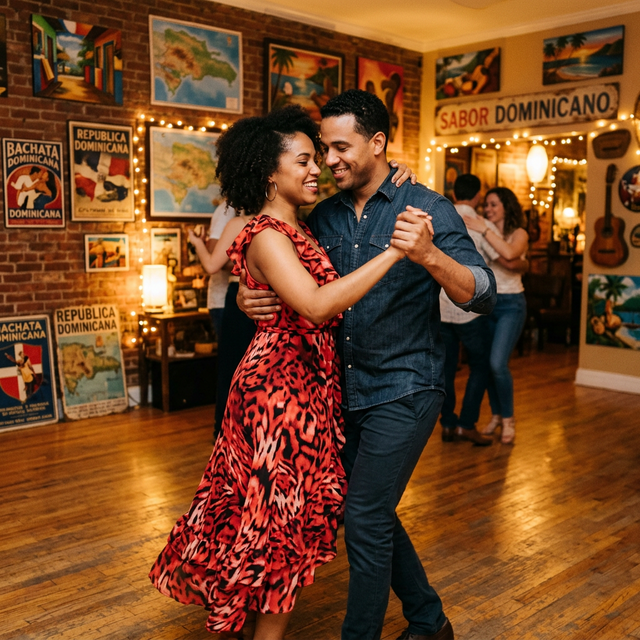
Bachata is typically danced in a close or semi-close embrace. For beginners, this is actually an advantage, not a challenge. When you're close to your partner, you can feel their movement more clearly, when they shift weight, you feel it. When they step, you feel the direction. It's like having built-in GPS for your dancing.
In dances with more open connection (like salsa or jive), beginners often struggle because the lead and follow signals need to travel through extended arms and hands, which requires more developed technique to communicate clearly. Bachata's closer connection shortcuts this learning curve dramatically.
4. It sounds like music you already know
Thanks to artists like Romeo Santos, Prince Royce, and Aventura, bachata has crossed over into mainstream pop. You may already recognize bachata songs before you know the genre name. This familiarity is a massive advantage. You're not learning to dance AND learning to hear new music simultaneously. One less thing for your brain to process means more capacity for movement.
Bachata as a gateway dance
Starting with bachata makes your first dance easy and every subsequent dance easier. The skills you develop in bachata transfer beautifully:
- Timing awareness transfers directly to salsa and merengue
- Partner connection is the foundation of all partner dancing
- Hip movement prepares you for cha cha, rumba, and samba
- Musical interpretation develops your ear for all Latin music
- Social confidence makes trying new dances feel less scary
Plenty of dancers start with bachata and expand into salsa, cha cha, and beyond. Bachata gives you the foundation, and the confidence, to explore everything else.
The bachata progression at Quartier Latin
A typical beginner's bachata journey at our Montreal studio looks like this:
- Lesson 1: Basic step, simple turns. You'll be dancing to music by the end of the class.
- Weeks 2–4: Body movement, simple combinations, partner connection techniques.
- Month 2: More complex turn patterns, dips, and the beginning of musicality.
- Month 3: You're social-dancing confidently. You can walk into a bachata social event and dance with anyone.
Three months from complete beginner to confident social dancer. No other partner dance consistently delivers this kind of timeline, and it's the reason I recommend bachata as the starting point for almost every new student who walks through our doors.
But what if I want to learn salsa?
Great, learn bachata first. I know that sounds counterintuitive, but students who start with bachata and then move to salsa tend to progress faster than those who jump straight into salsa. Why? Because bachata builds your rhythmic foundation, your partner connection skills, and your confidence without overwhelming you. When you then transition to salsa, you're only learning one new thing (the more complex footwork) instead of everything at once. Our rhythm training exercises for beginners build that foundation, and you can see why salsa is so popular in Montreal before you make the move.
Think of bachata as the on-ramp to the highway. You could merge directly into salsa's fast lane, but why would you when there's a smooth, scenic entrance that gets you there safer and more enjoyably?
Start your dance journey with bachata
Call for a free 15-minute chat. Tell us your goals and we will point you to the right class.
Alina Litvak, Founder of Quartier Latin Dance Studio
Two-time Canadian Champion • 19 Years Teaching Experience