Dance posture: how dancers fix what desk jobs break
Your desk is waging war on your spine. Dance fights back.
Quick answer
Can dance fix bad posture from desk work? Yes. Dance is one of the most effective posture correctives because it simultaneously strengthens the muscles that support good posture (core, back extensors, shoulders) while training body awareness, the ability to notice and correct your positioning in real-time.
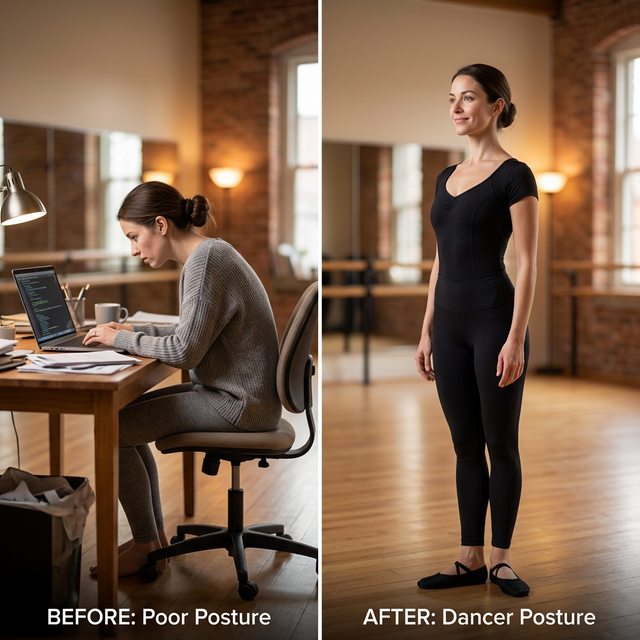
You can spot a desk worker from across the room before they take a single step. The shoulders roll forward. The chin juts out. The upper back rounds. The lower back either collapses or overcompensates with an exaggerated arch. Dance is one of the best ways to start undoing it.
The modern desk-bound lifestyle is devastating for posture. Canadians sit an average of 9.5 hours per day, and the body adapts to whatever position you hold most often. Sit hunched over a laptop for 40+ hours a week, and your fascia, muscles, and nervous system remodel themselves around that position. The result is what physical therapists call "upper cross syndrome", tight chest, weak upper back, forward head, rounded shoulders.
Dance doesn't just counteract this. It builds the opposite pattern into your muscle memory.
How dance corrects desk posture
Active core engagement
Unlike sitting (which essentially puts your core on vacation), dance requires continuous core activation. Every step, every turn, every balance point demands that your deep stabilizing muscles (transversus abdominis, multifidus, pelvic floor) work together. This isn't the "crunches at the gym" kind of core work. It's functional, three-dimensional stabilization that directly supports spinal alignment throughout your entire day, not just during exercise.
Shoulder reset
In partner dancing, your frame (the position of your arms, shoulders, and upper body) is critical for leading and following. A proper dance frame requires shoulders that are down and back, chest that's open, and shoulder blades that are gently engaged. Desk workers typically have the exact opposite: shoulders up and forward, chest collapsed, shoulder blades splayed apart. After just a few weeks of practicing proper dance frame, students begin carrying this shoulder position outside the studio automatically.
Spinal extension
Desks encourage spinal flexion (rounding forward). Dance demands spinal extension (lengthening upward). In ballroom and Latin dance, there's a concept called "standing tall through the crown of the head", imagine a string pulling the top of your skull toward the ceiling. This isn't just aesthetic; it decompresses the vertebral discs that get compressed during hours of sitting. Students consistently report reduced back pain after beginning dance, often within the first month.
Hip mobility
Sitting puts your hip flexors in a shortened position for hours. Over time, they adapt by getting chronically tight, which pulls your pelvis into an anterior tilt and creates lower back pain. Latin dance (particularly salsa, bachata, and cha cha) requires dynamic hip movement through a full range of motion. This actively lengthens and mobilizes hip flexors that sitting has locked down. Many of my students at Quartier Latin say their hip tightness improved more from dancing than from years of stretching.
The posture awareness effect
Beyond the physical strengthening and mobilization, dance creates something equally valuable: postural awareness. Most people with bad posture don't even know they have bad posture because they've lost the ability to feel their body's position in space. This is called proprioception, and desk work gradually erodes it.
Dance rebuilds proprioception aggressively. Every lesson, you're asked to notice where your weight is, how your spine is aligned, whether your shoulders are creeping up toward your ears. Over time, this awareness becomes automatic. Students start catching themselves slouching at their desks and self-correcting, not because they're trying to, but because their body has learned what good alignment feels like and naturally gravitates toward it.
Which dance styles are best for posture?
- Waltz & Foxtrot: The kings of posture work. These styles demand continuous upright carriage, strong frame, and elegant spinal extension. If posture is your primary goal, these are unbeatable.
- Tango: Requires a strong, proud chest position and precise core control. The dramatic pauses in tango are essentially isometric posture holds.
- Salsa & Bachata: Excellent for hip mobility and core engagement. The rhythmic movement patterns counteract the rigidity of desk sitting.
- Cha Cha: Combines core work, hip mobility, and upright posture in a playful, moderate-tempo package.
A simple test you can do right now
Stand against a wall with your heels, buttocks, shoulder blades, and the back of your head all touching. Does this feel strange or uncomfortable? If yes, your posture has shifted from its natural alignment. Now step away from the wall and try to maintain that position. Notice how quickly you revert to your habitual slouch. That gap between "wall posture" and "habitual posture" is exactly what dance closes over time, by making the wall posture feel like your natural posture. To see how this changes the way you carry yourself, read about building confidence through dance.
The Montreal desk worker's dance prescription
If you work a desk job in Montreal and your back, neck, or shoulders are paying the price, this is what I recommend based on 19 years of evening dance classes for office workers at Quartier Latin Dance Studio transform their posture:
- Two classes per week. This is the minimum frequency for posture changes to compound. Once a week maintains; twice a week transforms.
- Mix styles. Combine a Latin style (salsa, bachata) for hip mobility with a standard style (waltz, foxtrot) for upper body alignment.
- Practice the "dancer's check-in." Three times a day at your desk, run through a quick posture checklist: crown of head lifting, shoulders down and back, core gently engaged, feet flat. This takes 10 seconds and reinforces what you're learning in class.
Fix your posture the fun way
Our dance fitness classes transform your posture while you enjoy every minute, no boring exercises required.
Explore Dance FitnessAlina Litvak, Founder of Quartier Latin Dance Studio
Two-time Canadian Vice-Champion • 19 Years Teaching Experience