Body positivity on the dance floor: every body is a dance body
You don't need a dancer's body to dance. You have a body. That's the only requirement.
Quick answer
Do I need a specific body type to dance? No. This is one of the most damaging myths in dance. Every body type (tall, short, thin, heavy, flexible, stiff, young, old, able-bodied, and adaptive) can dance. Social dance, in particular, is designed for real bodies moving in real ways. What matters is how your body moves, not how it looks.
The image most people have of dancers comes from television: impossibly thin, impossibly flexible, impossibly young bodies doing impossibly athletic things. And that image keeps millions of people from ever stepping onto a dance floor, convinced that bodies like theirs don't belong there.
After 19 years of teaching at Quartier Latin Dance Studio in Montreal, I want to say something clearly: that image is a lie. And it's a lie that has stolen dance from people who would love it, benefit from it, and excel at it if they just showed up.
The lie of the "dancer's body"
The concept of a "dancer's body" was invented by ballet companies in the 20th century to create a uniform aesthetic on stage. It was always about visual homogeneity, not about ability. And it was always exclusionary by design, a gatekeeper to keep anyone who didn't fit the mould from participating.
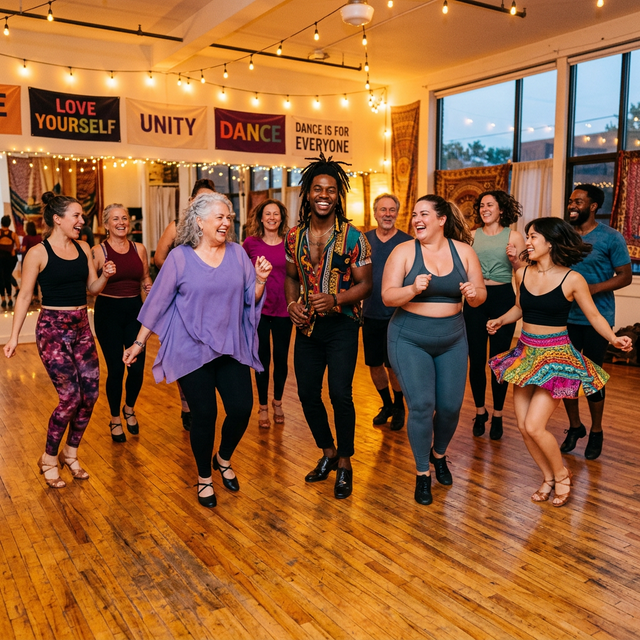
Social dance (salsa, bachata, tango, waltz, swing) has never operated under these rules. Look at the dance floors of Cuba, the Dominican Republic, Argentina, or Montreal's own Latin dance events. You'll see every body type, every age, every size. And you'll see them dancing beautifully, because social dance has never been about how you look. It's about how you connect.
How different bodies bring different strengths
- Larger bodies often have incredible natural rhythm and grounding. The weight and stability can create a powerful, authoritative presence on the dance floor. Some of the best leaders I've ever danced with are larger-framed, their lead is clear, stable, and confident.
- Compact bodies tend to excel at quick footwork, sharp turns, and agile direction changes. In salsa and cha cha, compact frames can be a significant advantage.
- Taller bodies create long, dramatic visual lines in waltz, foxtrot, and tango. The extension and sweep of their movement can fill a ballroom in ways that shorter dancers achieve differently.
- Less flexible bodies often develop exceptional strength and control to compensate, which gives their dancing a powerful, athletic quality.
- Older bodies bring musicality, patience, and emotional depth that younger dancers are still developing. A 70-year-old can dance with more soul than a 25-year-old competitor.
What I see vs. what students fear
When new students arrive at Quartier Latin, they often apologize for their bodies before they've taken a single step. "Sorry, I'm not very fit." "Sorry, I'm not flexible." "Sorry, I'm not young." These apologies break my heart because they reveal the depth of the lie: people have been conditioned to believe their bodies are problems to overcome rather than instruments to celebrate.
What I actually see when a new student walks in is potential. I see muscles that will discover new movement patterns. I see a brain that will light up with rhythm. I see a person who is about to learn something extraordinary about what their body can do.
The shift: from how you look to how you feel
Dance creates a fundamental shift in body relationship. Instead of evaluating your body from the outside (how does it look?), you begin relating to it from the inside (how does it feel?). This isn't just philosophical. It's neurological. Dance develops proprioception (body awareness), interoception (internal body sensing), and kinesthetic intelligence (understanding movement). These capabilities connect you to your body in ways that no number of mirror selfies ever could.
Dancing shifts the question from "how does my body look?" to "what can my body do?" That shift, from appearance to ability, is a freeing one. You can also read how dance builds confidence for women in Montreal.
Creating an inclusive dance space
At Quartier Latin Dance Studio, inclusivity is a practice. Concretely, that means:
- No mirrors on every wall. Mirrors are useful teaching tools, but wall-to-wall mirrors can increase body anxiety. We balance mirror use with mirror-free practice.
- No body commentary. We don't comment on students' bodies, weight, size, or appearance, only on their movement, technique, and progress.
- Adaptive instruction. Every move can be modified for different body types, physical limitations, or mobility challenges. No one is ever excluded from an exercise.
- Diverse representation. Our student community includes people of every body type, age, and background, because the best way to communicate that everyone belongs is to actually have everyone there.
The only body you need
If you have a body, you can dance. If your body moves, it can dance. If it doesn't move the way a TV dancer's does, it will move in its own way, and that way is valid, beautiful, and worthy of celebration. Dance doesn't require a specific body. Dance requires a willing heart and the courage to show up.
Your body belongs on the dance floor
At Quartier Latin, the only thing we judge is whether you're having fun. Come as you are.
Alina Litvak, Founder of Quartier Latin Dance Studio
Two-time Canadian Vice-Champion • 19 Years Teaching Experience
- Tags:
- Community
- Inclusivity