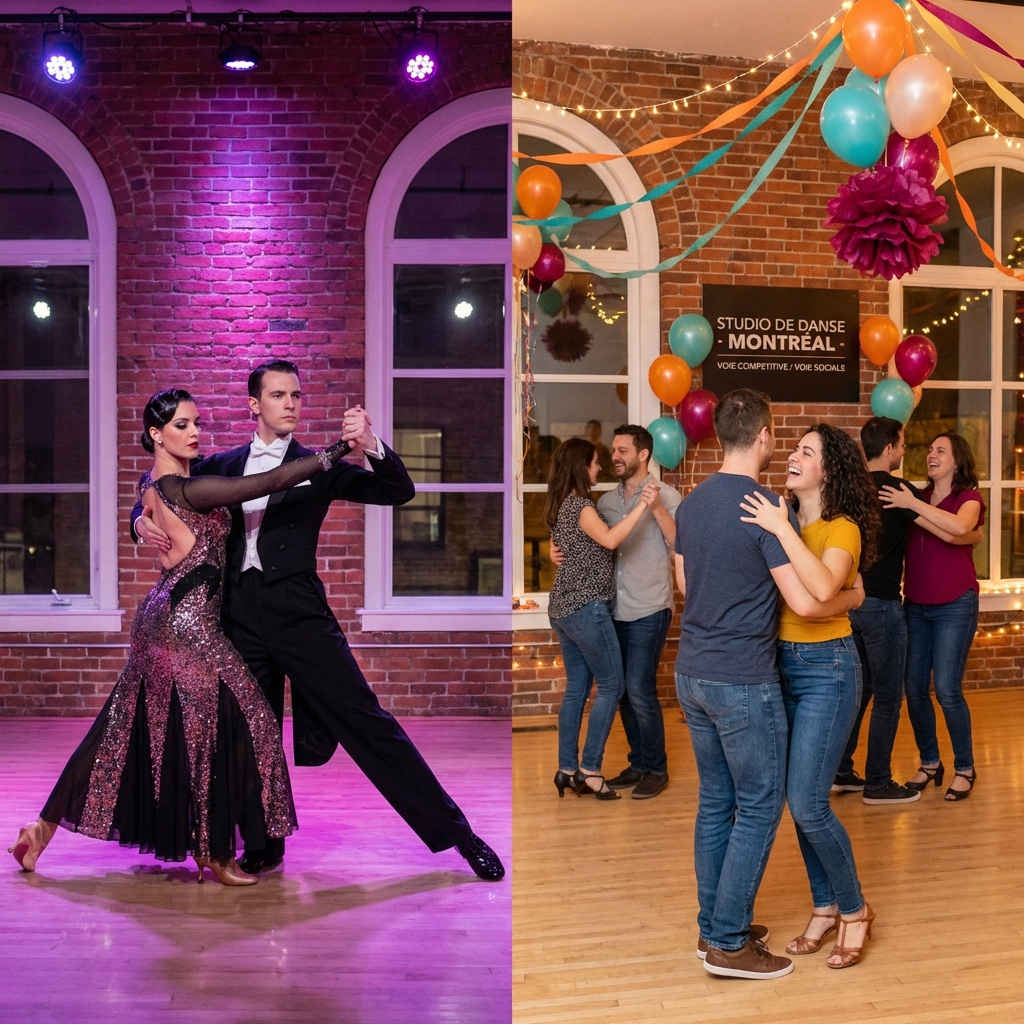
Competitive coaching vs. social prep: finding the right path for your goals
"I want to get serious about dance." But what does "serious" actually mean? For some, it's preparing to compete. For others, it's being the best dancer at every social event they attend.
These are very different goals, and they require very different approaches. Here is how to figure out which path is right for you.
The competitive path: what it really means
Competitive dancing isn't just "dancing better." It's an entirely different discipline with specific demands:
The training intensity
Competitive dancers train several times a week. Sessions are longer, more technical, and more physically demanding. You'll spend hours perfecting details that social dancers never think about: the angle of your head, the precise extension of your arm, the exact timing of your weight transfer.
The technical standard
Judges scrutinize everything: footwork, posture, musicality, partnership, expression. What passes at a social event would be heavily penalized in competition. Competitive coaching means rebuilding your technique from the foundation up.
The commitment
Beyond lessons, competition means costumes, entries, travel, and regular coaching. It's a big commitment of time and energy.
The mental game
Competition adds pressure that doesn't exist on the social floor. You'll perform in front of judges, cameras, and audiences. Managing nerves and performing under stress becomes part of your training.
The social path: deeper than you think
Don't mistake "social" for "unambitious." Social dance mastery has its own depth and rewards:
Versatility is king
Social dancers need to dance with anyone: beginners, intermediates, experts. This requires adaptability that competitors don't necessarily develop. Can you read a partner you've never met? Can you adjust your leading or following in real time? These are advanced skills.
Musicality over mechanics
Social dancing rewards interpretation. The same song never plays the same way twice when you're listening. Advanced social dancers aren't just executing steps. They're having a musical conversation with their partner.
The social dynamic
At a social event, you're rotating partners, navigating floor traffic, and managing energy over multiple songs. It's a marathon, not a sprint. The goal isn't to impress judges. It's to give every partner a great experience.
Connection over perfection
The best social dancers aren't always the most technically precise. They're the ones who make every partner feel confident, comfortable, and connected.
How to decide: key questions
Before committing to either path, ask yourself:
1. What actually excites you?
When you imagine yourself dancing a year from now, what do you see? Standing on a competition podium? Or being the person everyone wants to dance with at a crowded salsa social?
2. How much time can you realistically commit?
Competition requires consistent, intensive training. If you can only dance once a week, the social path might be more realistic and rewarding.
3. What's your relationship with perfection?
Competition demands perfectionism, and the ability to handle constant critique. Social dancing rewards "good enough" combined with excellent partner connection. Neither is better; they're different.
The hybrid approach
These paths aren't mutually exclusive.
Some dancers train competitively for the discipline and technique it provides, then apply those skills on the social floor without ever competing.
Others compete occasionally while spending most of their time at socials. Competitions give them goals and deadlines; socials give them joy and variety.
The key is understanding what each approach offers and choosing deliberately. For the social side, read about custom choreography that looks natural on the social floor and our addictively fun teaching method, or see how learning from a teacher compares with YouTube.
What changes in your lessons
When you come to me for private lessons, this conversation happens early. Because your goal fundamentally shapes your training:
For competitive prep:
- Intense focus on technique, posture, and footwork precision
- Choreography development for your specific routines
- Video analysis and detailed critique
- Performance coaching and stage presence development
- Mental preparation for competition pressure
For social mastery:
- Broad vocabulary across multiple styles
- Partner connection and communication skills
- Musicality training and improvisation
- Lead/follow technique for dancing with strangers
- Social floor etiquette and navigation
My honest assessment
Wanting to compete and wanting to feel confident at a friend's wedding are both good goals. Both require skill to teach.
The "right" path is the one that aligns with your actual goals, schedule, and resources, not the one that sounds more impressive.
If you're serious about either path, the starting point is the same: a conversation about where you want to go and an honest assessment of where you are now.
Ready to define your dance path?
Call for a free 15-minute chat and let's map out your goals together. Available in French, English, and Russian.