Rhythm training exercises for complete beginners
Think you have no rhythm? You're wrong. Find it with these exercises.
Quick answer
Can someone with no rhythm learn to dance? Yes, because "no rhythm" is almost never true. Rhythm is a neurological capacity that every healthy human brain possesses (it's how you walk, breathe, and speak). What people call "no rhythm" is actually unfamiliarity with a specific musical pattern. With targeted exercises, anyone can develop reliable rhythm within 2–4 weeks.
"I have no rhythm" is the number one thing that stops people from learning to dance. And after 19 years of teaching at Quartier Latin Dance Studio in Montreal, I can tell you with absolute scientific certainty: it's almost never true. Rhythm is as fundamental to the human brain as language. You use it every time you walk (left-right-left-right), every time you speak (stressed and unstressed syllables), and every time your heart beats. You have rhythm. You just haven't connected it to music yet.
Here are the exercises I use with every single beginner who tells me they're "rhythmically challenged." They work. Every time.
Exercise 1: the heartbeat clap
Time needed: 5 minutes
What you need: Any song with a clear beat
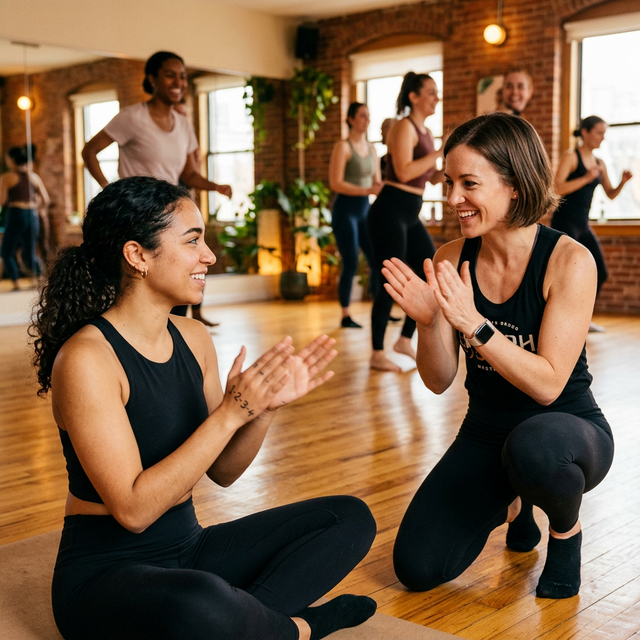
Put on a song you like, something with an obvious beat. Pop, rock, Latin, anything. Now simply clap along with the beat. Not the vocals, not the melody: the beat. The steady, pulsing foundation underneath everything else.
If you can't find the beat immediately, try tapping your foot instead of clapping. Feet tend to find rhythm more naturally than hands because walking is already a rhythmic activity. Once your foot is tapping consistently, match your claps to your taps.
Success indicator: You can clap consistently on every beat for a full minute without losing time.
Exercise 2: The March
Time needed: 5 minutes
What you need: Same song
Once you can clap on the beat, transfer that rhythm to your feet. March in place (left, right, left, right) each foot hitting the ground on a beat. This is already dancing. Seriously. Walking on rhythm is the foundation of every dance style in the world. You are now dancing. It doesn't look dramatic, but the neurological connection between your ears, your brain, and your feet is the exact same one used in salsa, waltz, and everything in between.
Success indicator: You can march consistently on beat for a full song without stopping or losing time.
Exercise 3: the two-beat pattern
Time needed: 10 minutes
What you need: A moderate-tempo song
Now add a pattern. Instead of stepping on every beat, step on alternating beats: step-hold-step-hold. This is the basic principle behind most partner dances, not every beat gets a step. Practice this until the "hold" feels as natural as the "step." Your body needs to learn that silence is part of rhythm, not a gap in it.
Variation: clap on the beats where you hold instead of step. Now you're doing two different rhythmic activities simultaneously, welcome to coordination, the next level of rhythm development.
Exercise 4: the metronome challenge
Time needed: 5 minutes
What you need: A free metronome app on your phone
Set a metronome to 100 BPM (beats per minute). March in place on each click. Once that's comfortable, try 120 BPM (faster). Then 80 BPM (slower, counterintuitively, slower is harder because the gaps between beats are longer, and your body wants to rush). Then try 140 BPM. The ability to maintain rhythm at different speeds is what separates a rhythmically confident dancer from one who can only dance to familiar tempos.
Exercise 5: the kitchen practice
Time needed: Zero (you're already cooking)
What you need: Music playing while you cook
This is my favourite exercise because it requires no extra time. Play music while you cook and consciously step, sway, or move to the beat as you work. Stir on the beat. Chop on the beat. Walk to the fridge on the beat. You're training your brain to connect everyday movement to musical rhythm. Over weeks, this passive practice builds a deep, intuitive sense of timing that shows up the moment you step onto a dance floor.
Exercise 6: counting music
Time needed: During your commute
What you need: Music + your ears
Play a song and count "1-2-3-4, 1-2-3-4" along with the beat. Most popular music is in 4/4 time, meaning the beats naturally group into sets of four. Once you can count consistently, try to identify beat 1 specifically, the "downbeat" where each musical phrase starts. In Latin music, beat 1 usually coincides with a bass note or a drum accent. Learning to find beat 1 is the single most important rhythm skill for dance, because it's where your basic step starts.
The two-week rhythm training plan
- Days 1–3: Heartbeat Clap + March exercises. 10 minutes daily.
- Days 4–7: Add the Two-Beat Pattern. 10 minutes daily.
- Days 8–10: Add the Metronome Challenge at various speeds. 10 minutes daily.
- Days 11–14: Count music during your commute + Kitchen Practice during meals.
By day 14, you will have a reliable sense of rhythm. Not because you magically "found" it, but because you trained it, the same way you'd train any other skill.
Then what?
Once you have basic rhythm, you're ready for a dance class. The rhythm exercises above build the neurological foundation. A class at Quartier Latin Dance Studio adds the movement vocabulary, partner skills, and social experience that transform rhythm into dance. The foundation you build at home makes your first class dramatically more comfortable and productive. To go further, see how to find the 1 in salsa timing, what musicality in dance means, and the best songs for your first dance lesson.
Ready to put your rhythm to work?
You've got the rhythm, now let's turn it into dance. Beginner classes at Quartier Latin welcome you exactly where you are.
Alina Litvak, Founder of Quartier Latin Dance Studio
Two-time Canadian Vice-Champion • 19 Years Teaching Experience