Dance as a cure for loneliness: building community one step at a time
In a city of millions, the dance floor is where strangers become friends in one song.
Quick answer
Can dance help with loneliness? Yes, and it does so through three mechanisms that most social activities lack: physical touch (triggers oxytocin and social bonding), structured social interaction (removes the anxiety of unstructured socializing), and shared progressive challenges (creates genuine friendships through mutual growth). Dance is one of the few activities that combats loneliness physically, emotionally, and socially simultaneously.
Loneliness is Canada's quiet epidemic. Being surrounded by people doesn't guarantee connection. In Montreal (a city famous for its warmth, culture, and social energy) loneliness still finds its way into apartments, workplaces, and routines.
Many people come to dance looking for connection as much as dance skills, and a regular class gives you that.
Why dance fights loneliness better than other activities
Physical touch in a touch-starved world
We live in an era of unprecedented physical isolation. Remote work, delivery apps, and digital communication have reduced physical human contact to historic lows. And our bodies are suffering for it, humans are wired to need touch for emotional regulation, stress reduction, and social bonding.
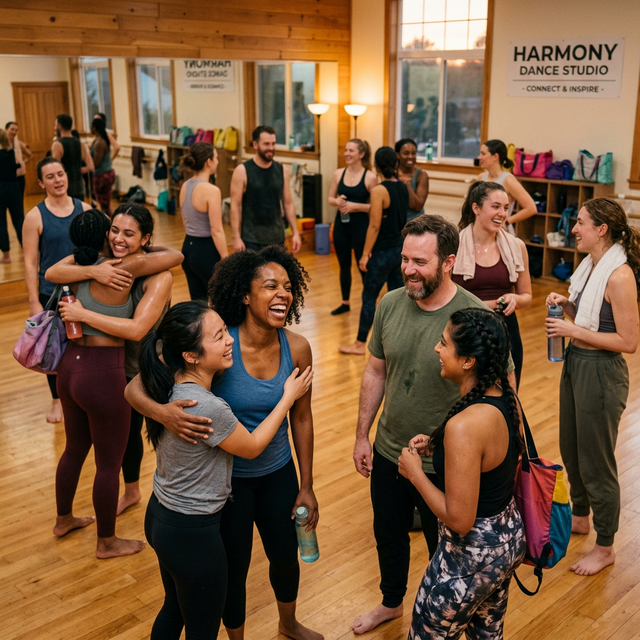
Dance restores this in the most natural way possible. Every class involves sustained, appropriate physical contact with multiple people. You hold hands. You share a frame. You lean into a dip. You high-five after a successful pattern. This physical contact triggers oxytocin release, the bonding hormone, and creates a sense of connection that texting and Zoom calls simply cannot provide.
Structured socializing removes anxiety
One of the cruellest aspects of loneliness is that the people who suffer from it most often find unstructured social situations (bars, parties, networking events) anxiety-inducing rather than relieving. Dance class solves this elegantly. There's a clear structure: you arrive, you warm up, you learn, you practice, you rotate partners, you socialize naturally during breaks. You're never standing alone wondering what to do or who to talk to. The activity creates the social interaction, removing the pressure to generate it yourself.
Built-in conversation starters
After dancing together, you don't need a conversation topic. You have one. "That turn was tricky, right?" "What did you think of the footwork?" "How long have you been coming here?" Dance creates shared experience in real-time, which is the raw material of friendship. Unlike networking events where you're grasping for common ground, the dance floor provides common ground automatically.
Progressive bonds through shared growth
The friendships that form in dance class tend to be unusually strong because they're built on shared growth rather than shared convenience. You struggle together, improve together, celebrate milestones together, and support each other through frustrating plateaus. These "growth friendships", as psychologists call them, are more durable and satisfying than friendships based solely on proximity or circumstance.
Who finds community through dance
At Quartier Latin Dance Studio in Montreal, Dance can build community for:
- Newcomers to Montreal. People who have recently moved to the city and don't have an established friend group. Dance class becomes their first social anchor, and classmates often become their first Montreal friends.
- Post-divorce or post-breakup. After a long-term relationship ends, many people realize their entire social circle was shared with their ex-partner. Dance provides an independent social world that belongs entirely to them.
- Empty nesters. Parents whose children have moved out often experience a sudden social vacuum. Dance fills it with an active community.
- Remote workers. People who work from home and go days without meaningful in-person interaction. Dance class becomes their most reliable source of face-to-face human contact.
- Retirees. The transition from workplace social structures to retirement can be isolating. Dance provides a consistent weekly community commitment that replaces the social function of work.
From classmates to friends: how it happens
The friendship progression at Quartier Latin typically follows this pattern:
- Week 1–3: You recognize the same faces. You exchange names. You share nervous laughter about shared mistakes.
- Week 4–6: You start arriving early or staying late to chat. You have a "usual" spot. You notice when someone is absent.
- Week 7–10: The post-class coffee or drink begins. You exchange phone numbers. You attend a social dance event together.
- Month 3+: These are genuine friends. You text about non-dance things. You attend each other's events. The dance studio is no longer just a class. It's a community you belong to.
The Montreal advantage
Montreal is uniquely positioned for dance-based community building. The city's multicultural fabric means a dance class brings together people from many backgrounds. In a class you meet people you might never encounter in your regular routine. We teach in English, French, and Russian, and our students speak dozens more. Dance transcends language barriers in a way that few other activities can. For more, see why adults are falling in love with dance or why couples who dance together stay together.
Find your people on the dance floor
Call for a free 15-minute chat. Tell us your goals and we will point you to the right class.
Alina Litvak, Founder of Quartier Latin Dance Studio
Two-time Canadian Vice-Champion • 19 Years Teaching Experience