Why couples who dance together stay together
What 19 years of teaching couples has shown us, and why it works.
Quick answer
Do couples who dance together stay together? In our studio, couples who keep showing up to class tend to stay close. Shared new experiences strengthen a pair bond, and dance packs four of them into one hour: touch, non-verbal communication, trust and moving in sync.
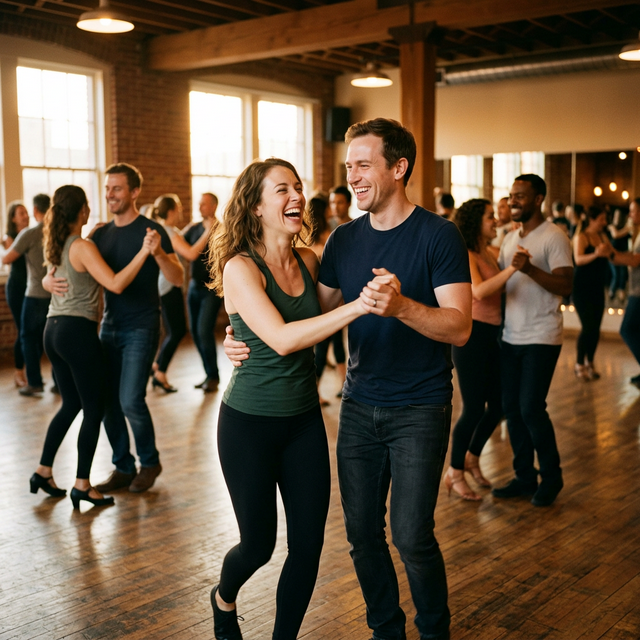
I've taught dance to couples in Montreal for 19 years at Quartier Latin Dance Studio. Dancing together gets partners moving, laughing and touching again, and brings you closer, so you reconnect and strengthen their relationship.
What we see in the room matches what psychologists say about how couples bond.
The science of synchronized movement
Psychologists call it behavioral synchrony: when people who move in rhythm together feel closer. You see it in rowing crews, choirs and marching bands. The same pull shows up beyond couples: see how dance builds community and connection and how it works as team building for work groups.
Partner dance takes synchrony further. You move in matching, complementary patterns, answer each other's bodies in real time and share space with trust. That is why a first partner class feels so different from a night at the movies.
The five bonding mechanisms of partner dance
1. Oxytocin through touch
Physical touch triggers oxytocin release: the bonding hormone. In long-term relationships, non-sexual physical contact often declines gradually and invisibly. Dance reverses this by creating sustained, purposeful physical contact for 45 to 60 minutes per session. Regular touch rebuilds the small physical habits that fade in long relationships.
2. Vulnerability creates intimacy
Learning something new together requires vulnerability: the willingness to look foolish, make mistakes, and be seen struggling. Few things bring two people closer than being new at something together. Dance class is a safe place to practice that, and the support you give each other carries over to how you handle life outside the studio.
3. The novelty effect
Couples who try new, exciting things together tend to feel happier together than couples stuck in routine. Dance keeps changing, with new steps, new songs and new social nights, so it stays fresh in a way dinner and a movie can't.
4. Non-verbal communication training
Couples communicate mostly through words. Dance teaches a completely different communication channel: physical signals, body awareness, spatial responsiveness. Couples who dance together read each other's physical cues, which makes every kind of communication easier. They notice tension in each other's shoulders. They read mood through posture. They understand comfort and discomfort through touch.
5. Shared achievement
Every new step mastered, every clean turn executed, every song danced from start to finish without mistakes: these are shared victories. And shared victories create a sense of "we can do hard things together" that becomes a relationship superpower when applied to life's larger challenges.
What I see at Quartier Latin
Couples who dance regularly at our studio often show the same changes:
- They touch more casually. After a few weeks of dancing, couples start holding hands on the way out, touching each other's backs, making small physical contact gestures they'd stopped doing.
- They laugh together more. Dance inevitably produces funny moments: missteps, wrong turns, accidental collisions. Couples who can laugh at these moments together are practicing one of the most important relationship skills: not taking themselves too seriously.
- They have something to talk about. "How was your day?" gets stale after a few years. "Remember when we finally nailed that cross-body lead?" doesn't. Dance gives couples a shared language, shared goals, and shared memories that sustain conversation.
- They show up for each other. Even on days when one partner is tired or stressed, they show up because they committed to the class together. This regular act of showing up (of choosing the relationship over the couch) compounds over time.
Starting together doesn't mean starting equal
One of the most common concerns couples express is: "What if one of us is better than the other?" The answer: one of you will be better than the other. Always. And that's fine. The beauty of partner dance is that it's collaborative, not competitive. The "better" partner's role is to support the other's growth, and the "learning" partner's willingness to try is what keeps the experience joyful for both.
In fact, the asymmetry often becomes a source of tenderness in the relationship: the moment when the stronger dancer slows down to match their partner's pace, or the moment when the struggling partner breaks through a challenge, are both relationship-deepening experiences.
Start with one call
Tell us where you two are starting from. We'll tell you how a private couples lesson fits. The call is free and takes 15 minutes.
Alina Litvak, Founder of Quartier Latin Dance Studio
Two-time Canadian Vice-Champion • 19 Years Teaching Experience
- Tags:
- Couples
- Relationships