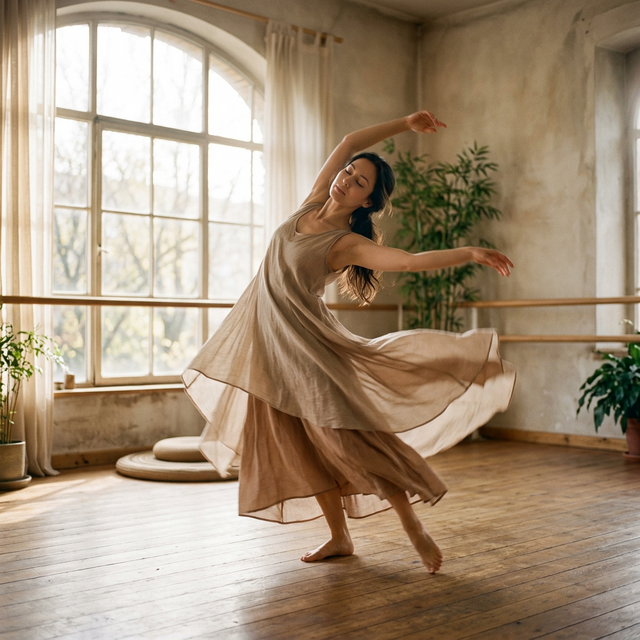
Dance as moving meditation: your workout and your calm in one class
When your workout, your therapy, and your meditation are all the same thing.
Quick answer
Is dance a form of meditation? Yes, for many people. Dance pulls you into a flow state, where thoughts quiet down and you feel fully present. Unlike seated meditation, you also get cardio, strength work and good company.
I've tried meditation apps. I've sat cross-legged on a cushion. I've followed guided breathing exercises. And if I'm honest, I've found traditional meditation hard. My mind races. My body fidgets. My inner critic tells me I'm doing it wrong.
Then I step onto the dance floor, and within thirty seconds, every thought dissolves. The music starts, my body responds, and I'm in a state of complete present-moment awareness that no meditation app has ever matched. After 19 years of teaching at Quartier Latin Dance Studio in Montreal, I'm convinced that dance is meditation for people who can't sit still.
The neuroscience of flow in dance
The state I'm describing has a scientific name: flow. First identified by psychologist Mihaly Csikszentmihalyi, flow is a mental state where you are fully absorbed in an activity, losing track of time and self-consciousness. It's characterized by:
- Reduced activity in the default mode network: the brain region responsible for rumination, self-criticism, and worry
- More alpha and theta brainwaves: patterns also seen in people who meditate
- Transient hypofrontality: a fancy term for your analytical brain temporarily quieting down, allowing intuitive, creative processing to take over
- Release of dopamine, endorphins, and norepinephrine: creating a state of focused euphoria
Dance is one of the most reliable flow triggers because it combines multiple flow prerequisites simultaneously: clear goals (execute the step), immediate feedback (did it work?), challenge-skill balance (not too easy, not too hard), and deep concentration (the music demands attention).
Why dance meditation beats seated meditation
1. The body is the anchor
In traditional meditation, you anchor your attention to your breath, a very subtle sensation that's easy to lose. In dance, your anchor is your entire body moving through space to music. It's a massive, unmissable anchor. Your mind doesn't wander because there's too much happening for it to wander to. The music, the movement, the partner, the rhythm. It's a sensory feast that naturally holds your attention in the present moment.
2. Cardiovascular benefits
Seated meditation calms the mind but doesn't work the heart. An hour of social dancing lifts your heart rate and builds fitness while you stay in that absorbed, present state. One class, two wins.
3. Social connection
Meditation is typically solitary. Dance, especially partner dance, adds the dimension of human connection, physical touch, non-verbal communication, shared experience. The combination of meditative flow AND social connection is extraordinarily powerful for mental health. Dance gives you mindfulness and connection in the same hour.
4. Emotional processing
Seated meditation observes emotions. Dance expresses them. When you're sad, a slow rumba lets you feel and release that sadness through movement. When you're joyful, a cha cha channels that energy into playful expression. When you're angry, a tango transforms that intensity into dramatic art. This active emotional processing, feeling emotions through your body rather than just observing them in your mind, can be deeply therapeutic.
What dancers often notice
- Better sleep on class nights. Physical effort plus mental release is a good recipe for a restful night.
- An hour away from work. At the gym your mind can drift to your inbox. In dance, the music and your partner keep you here.
- A reset. Flow breaks the stress loop, and the calm after class can last into the next day.
- Exercise you look forward to. The best wellness habit is the one you keep. Dance is fun enough to keep.
The dance styles most conducive to flow
- Argentine Tango: The most meditative of all dances. The close embrace, the improvised movement, and the deep musicality create a hypnotic flow state.
- Bachata: The slower tempo and sensual movement create a deeply embodied, present-moment experience.
- Waltz: The circular, flowing movement in three-quarter time has a naturally trance-like quality.
- Salsa: Faster-paced flow, more energizing than calming, but equally effective at silencing the inner critic.
How to experience dance meditation
You don't need to be a skilled dancer to experience the meditative benefits of dance. Even in your first class, there will be moments, brief at first, then longer, when the thinking stops and the moving takes over. Those moments are meditation. With practice, they become the default state, and the thinking becomes the exception.
Move your body, quiet your mind
Our dance fitness classes pair movement with a full-body workout, no cushion required. Call for a free 15-minute chat and we'll point you to the right class.
Alina Litvak, Founder of Quartier Latin Dance Studio
Two-time Canadian Vice-Champion • 19 Years Teaching Experience
- Tags:
- Wellness
- Mindfulness