Overcoming "two left feet": how private coaching breaks down technical barriers
"I have two left feet." I hear this phrase at least twice a week. It's said with a nervous laugh, usually by someone standing in my studio doorway, convinced they're uniquely uncoordinated.
Here's my response after 19 years of teaching: "Two left feet" is a starting point, not a diagnosis.
The myth of the "non-dancer"
Let's address this directly: there is no "dance gene." Coordination isn't something you either have or don't have. It's something you develop. Every smooth dancer you've ever admired started somewhere, usually looking exactly as awkward as you feel right now.
The belief that you "can't dance" usually comes from one of three sources:
- An embarrassing moment at a wedding or party years ago
- Comparison to someone naturally gifted (usually a sibling or friend)
- A single bad experience in a group setting
None of these actually mean you can't learn. They mean you haven't learned yet.
Why group classes sometimes fail "two left feet" students
I teach group classes, and I love them. But I'll be honest: for some students, group settings aren't ideal, at least not at first.
In a group class:
- The pace is set by the average skill level
- Individual corrections are limited by time
- Students often compare themselves to faster learners
- Specific technical issues can't be addressed in depth
If you're someone who needs things broken down more slowly or differently, you might leave group classes feeling more frustrated than confident.
The private lesson difference
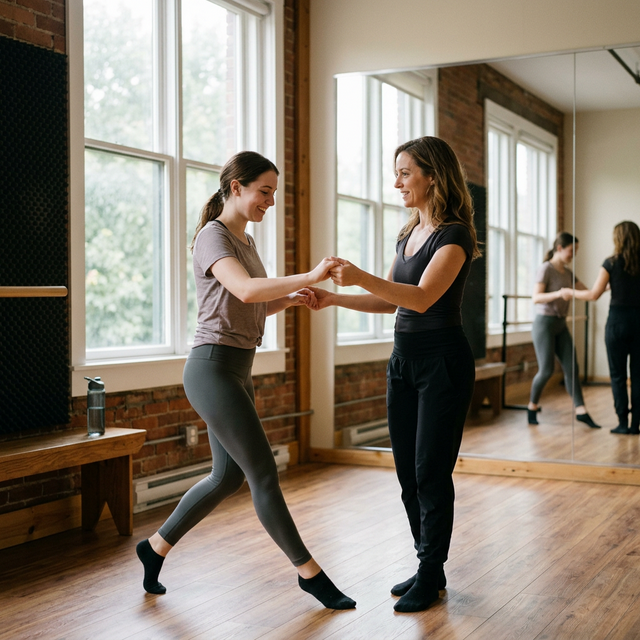
In a private lesson, everything changes. Targeted, one-on-one instruction gives you this:
Identify the actual problem
"I can't turn" isn't specific enough to fix. But "you're looking down and shifting your weight too late". That's something we can work with. Private lessons let me diagnose exactly where your movement breaks down.
Customize the approach
Everyone learns differently. Some students need visualizations. Others need to feel the movement in their body before they can understand it. Some need detailed technical explanations; others get overwhelmed by too much information. In private lessons, I adjust my teaching to match how you learn.
Build confidence without witnesses
Let's be real: learning is messy. People who feel self-conscious in group settingsoften relax and progress faster when it's just them and the instructor. No one's watching. No comparisons. Just focused practice.
Progress at your pace
We move on when you're ready, not when the class schedule says so. If you need three sessions on footwork fundamentals, that's what we do. If you nail something quickly, we accelerate.
Common technical barriers I deconstruct
After 19 years of teaching, these are the "two left feet" patterns that come up most:
The timing disconnect
Some people struggle to find the beat. Talent has little to do with it. Usually they have never practiced listening for it. We start with clapping exercises before adding any footwork.
The body awareness gap
Many adults have spent years in desk jobs, disconnected from how their body moves. We rebuild this awareness systematically, starting with simple isolated movements.
The tension trap
Nervous dancers hold tension everywhere, especially shoulders and hips. This makes smooth movement physically impossible. I teach relaxation techniques specific to dance.
The pattern overwhelm
Some students can do individual steps but panic when asked to combine them. We address this by building patterns gradually, never adding complexity until the foundation is solid.
The first three lessons: what to expect
If you're considering private lessons, here's a realistic picture of the beginning:
Lesson 1: Assessment. I watch how you move, identify your specific challenges, and establish a baseline. We'll do some basic exercises to understand your current coordination level.
Lesson 2: Foundation work. We address the most fundamental issue identified in lesson one. This might be stance, timing, or basic weight transfer. You'll leave with specific practice exercises.
Lesson 3: Progress check. We review your at-home practice, refine what's working, and begin introducing the next level of complexity.
By the end of three lessons, most "two left feet" students already feel noticeably more coordinated.
When private lessons + group classes work together
Private lessons aren't necessarily forever. Plenty of students start with a block of private lessons to build their foundation, then transition to group classes for continued learning and social practice.
They show up to groups prepared, confident, and able to keep pace, something that might not have been possible if they'd started in a group setting. If your goals go further, see how competitive coaching differs from social prep.
Why a strong foundation pays off
Struggling through months of group classes you don't fully absorb is slow. A few focused private sessions give you the foundation to really learn.
Building your fundamentals early makes every later class easier.
You're closer than you think
If you've been calling yourself a "two left feet" case, I want you to reconsider. That label has probably held you back from experiences you'd actually enjoy.
Dancing is learnable. Coordination is trainable. And with the right approach, you can go from clumsy to confident. That is what private coaching is for.
All you need is the decision to start.
Ready to overcome your technical barriers?
Call for a free, no-pressure 15-minute chat and let me show you what's actually possible. Available in French, English, and Russian.