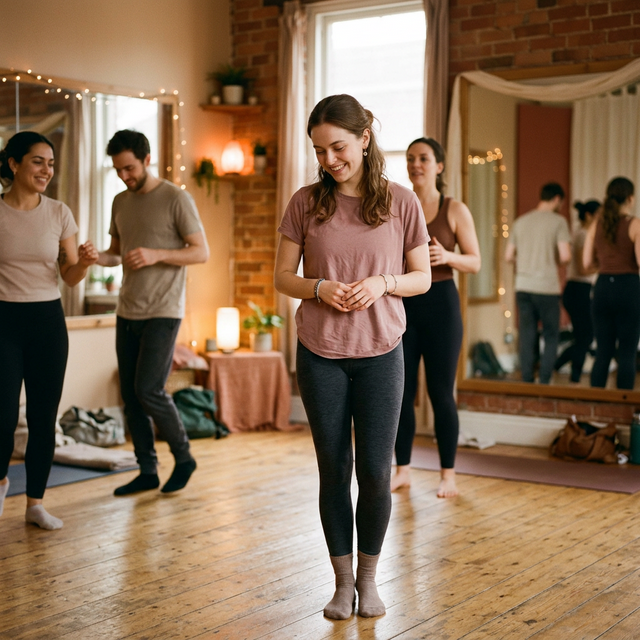
Dance classes for introverts: a quiet person's guide
You don't have to be the loudest person in the room to be the best dancer.
Quick answer
Can introverts enjoy dance classes? Yes, and dance suits quiet people well. Dance offers structured social interaction (no small talk required), deep focus, and a physical outlet for emotions that introverts often struggle to express verbally. Private lessons are especially well-suited for introverts who prefer one-on-one learning.
Some of the best dancers in any room are the quiet ones. The observers. The people who spend the first class watching more than moving, then turn out to have precision and musicality to spare.
After 19 years of teaching at Quartier Latin Dance Studio in Montreal, we believe introversion and dance are far more compatible than most people think. We also understand why introverts hesitate, so let's take each worry in turn.
Why introverts hesitate, and why each fear is smaller than it seems
"I'll have to dance with strangers"
In group classes, yes, partner rotation is common in most social dance classes. Partner dancing is actually a form of structured social interaction that many introverts find easier than typical socializing. There's no awkward small talk. There's no pressure to be entertaining. The dance itself is the conversation, and it follows clear rules. You know exactly what's expected of you, step here, turn there, follow the lead. For people who find unstructured social situations draining, this clarity is a relief, and the one tricky moment, asking someone to dance, has simple scripts.
That said, if the idea of group classes feels like too much right now, private lessons are a perfect alternative (see what private lessons offer). Starting one-on-one and moving to a group class when you feel ready is a common path.
"Everyone will watch me mess up"
Everyone in a beginner class is too focused on their own feet to notice yours. Everyone is a beginner. Everyone is nervous. And in a well-run class, the atmosphere is supportive, not judgmental. If confidence is your main worry, read how dance quietly builds real confidence.
"I'll be drained afterward"
This is where dance defies expectations for introverts. Most social activities drain introverts because they require sustained verbal interaction and performance. Dance replaces verbal communication with physical communication, which operates through a completely different mental channel. You can leave class energized but calm, a combination that is rare after a social event.
The music, the movement, and the focused attention actually function like a reset button for the introvert's overstimulated nervous system. You leave class having been deeply social but without the typical social hangover.
Why introverts make strong dancers
Introverts also bring real advantages to dance.
- Observation skills. Introverts are natural observers. In dance, observation is how you learn. While extroverts are chatting and socializing between exercises, introverts are watching the teacher's feet, noticing the subtleties of the lead, and absorbing details that others miss.
- Deep practice. Introverts tend to favor quality over quantity in their practice. They don't just repeat steps. They analyze them. This depth-first approach leads to cleaner technique and faster mastery.
- Emotional depth. Dance is ultimately about expression, and introverts often have a rich inner emotional life that translates beautifully into movement. The introvert who struggles to express feelings verbally may discover that their body speaks with extraordinary eloquence.
- Listening ability. In partner dancing, the ability to listen (through touch, through the music, through your partner's body language) is more important than the ability to lead loudly. Introverts are, by nature, exceptional listeners.
- Focus. Dance classes require sustained concentration, which is a natural strength for most introverts. While the external stimulation of a loud, energetic class might initially feel overwhelming, introverts quickly learn to channel their focus inward, which is exactly where it needs to be.
The introvert's guide to choosing the right class
Not all classes are equally introvert-friendly. Look for these:
- Smaller class sizes. Look for a class small enough that the teacher sees you, not a packed room.
- Private lessons first. If group settings feel overwhelming, start with private lessons to build your skills and confidence in a one-on-one environment. It is the gentlest way to start.
- Avoid "party-style" classes. Some studios lean on loud music, shouting, and high-energy theatrics. These can be fun, but they're often overwhelming for introverts. Look for studios that balance energy with structure and technique.
- Choose styles that match your energy. Bachata and waltz tend to suit introverts beautifully. They're intimate, musical, and don't require high-energy showmanship. Salsa and jive are equally learnable but may feel more intense initially.
Start quiet, start small
If you're an introvert considering dance, our advice is simple: start. Start with private lessons if group classes feel like too much. Start with bachata if you want something gentle. Start with one class per week if more feels overwhelming. You can meet the teachers on our team page before your first class. The community you'll find on the dance floor communicates through movement rather than words, and that suits quiet people well.
Learn at your own pace
Call for a free 15-minute chat and we will find the calm, one-on-one start that fits you.
Alina Litvak, Founder of Quartier Latin Dance Studio
Two-time Canadian Champion • 19 Years Teaching Experience