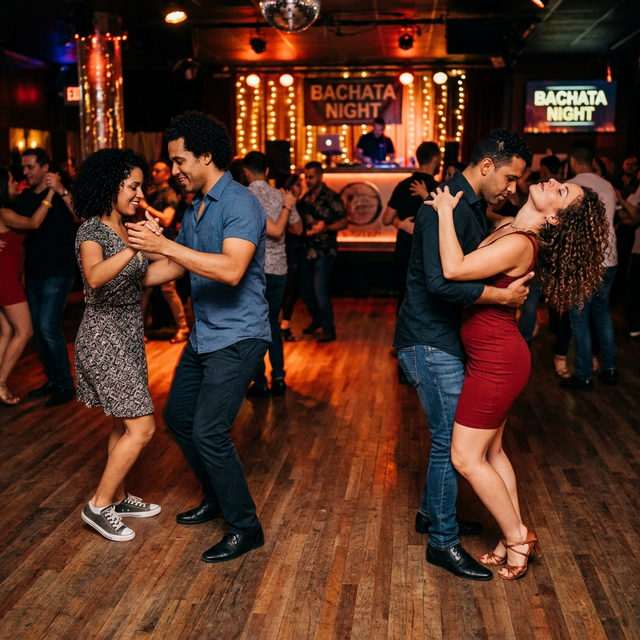
Bachata sensual vs. traditional: what's the difference?
Same name, two completely different worlds. Here's the honest breakdown.
Quick answer
Traditional bachata uses footwork-focused patterns, maintains more space between partners, and dances to classic Dominican guitar music. Bachata sensual leans on body waves, isolations, close connection, and contemporary remixes. Both share the same 4-beat basic step but feel like very different dances. Most social dancers learn elements of both.
When students at Quartier Latin Dance Studio in Montreal say they want to learn bachata, I always ask: "Which bachata?" Most people don't realize that "bachata" has evolved into at least two distinct styles with very different aesthetics, techniques, and music.
Below: both styles, their history, their differences and how to pick the one for you.
Traditional bachata: the Dominican original
Traditional bachata (also called Dominican bachata or bachata auténtica) is the original form of the dance, born in the Dominican Republic in the 1960s. It was originally dance-hall music of the lower classes, raw, emotional guitar ballads about love, heartbreak, and daily life.
The movement style
- Footwork-centric. Traditional bachata is built on detailed footwork patterns, syncopations, taps, kicks, and slides that play with the rhythm.
- Upright posture. Dancers maintain a more upright frame with space between their upper bodies.
- Playful energy. The mood is often flirtatious and joyful rather than deeply sensual.
- Partner interaction. Lots of turns, partner play, and rhythmic games between leader and follower.
- Close to the music. Every step relates directly to specific sounds in the guitar and percussion.
The music
Classic bachata music features acoustic guitar (the dominant instrument), bongo drums, güira (a metal scraper), and bass. Artists like Juan Luis Guerra, Luis Vargas, and Anthony Santos define the traditional sound. The guitar "strings", the melodic runs between vocal phrases, are central to the music and the dance.
Bachata sensual: the modern evolution
Bachata sensual emerged in Spain in the early 2010s, pioneered by dancers like Korke and Judith, and later popularized by Daniel and Desiree. It took the basic bachata step and layered on contemporary dance elements inspired by zouk, contemporary dance, and body movement techniques.
The movement style
- Body movement-centric. Body waves, isolations (chest, hips, head), and fluid circular movements are the hallmarks.
- Close connection. Dancers are typically in a closer embrace, with upper body contact facilitating body movement communication.
- Dramatic and emotional. The aesthetic is cinematic, think music video choreography rather than social dance hall.
- Musical interpretation. Heavy emphasis on matching body movement to musical dynamics, soft movements for verses, dramatic movements for drops.
- Dips and leans. More dramatic use of off-axis movement and trust-based positions.
The music
Bachata sensual is often danced to remixed versions of popular songs. R&B, pop, and electronic music given a bachata rhythm. Artists like DJ Tronky, Dj Khalid, and bachata covers of songs by Ed Sheeran, Adele, or The Weeknd are common at sensual bachata events. The music is often more atmospheric and emotionally dramatic than traditional bachata.
The key differences at a glance
- Footwork vs. Body: Traditional emphasizes feet; sensual emphasizes torso and isolations.
- Space vs. Closeness: Traditional maintains more partner distance; sensual uses close contact.
- Dominican vs. Global: Traditional is rooted in Dominican culture; sensual is a global fusion.
- Guitar vs. Remixes: Traditional dances to guitar bachata; sensual dances to remixes and covers.
- Playful vs. Dramatic: Traditional is flirtatious; sensual is cinematic.
Which should you learn?
Here is my guidance for choosing:
- Learn traditional first if: You want a solid foundation, you enjoy footwork and rhythm, you plan to social dance primarily, or you want to understand bachata's cultural roots.
- Learn sensual first if: You're drawn to body movement and expression, you enjoy dramatic musical interpretation, or you're primarily attending modern bachata festivals and events.
- Learn both: The most versatile social dancers have elements of both styles. Traditional footwork combined with sensual body movement creates a rich, complete bachata vocabulary.
The Montreal bachata scene
Montreal's bachata scene is busy and varied. You'll find both traditional and sensual bachata at social events across the city. Most social nights mix both styles of music, so being able to adapt is a real advantage. At Quartier Latin, we teach elements of both traditional and sensual bachata, giving students the versatility to enjoy any event. New to the dance? Start with our complete guide to bachata, hear the difference in a Latin dance music playlist, or explore tango, another close-connection dance, in our complete guide to tango.
Discover your bachata style
At Quartier Latin, we teach both traditional and sensual bachata, find the style that speaks to your soul.
Alina Litvak, Founder of Quartier Latin Dance Studio
Two-time Canadian Vice-Champion • 19 Years Teaching Experience
- Tags:
- Bachata
- Dance Styles