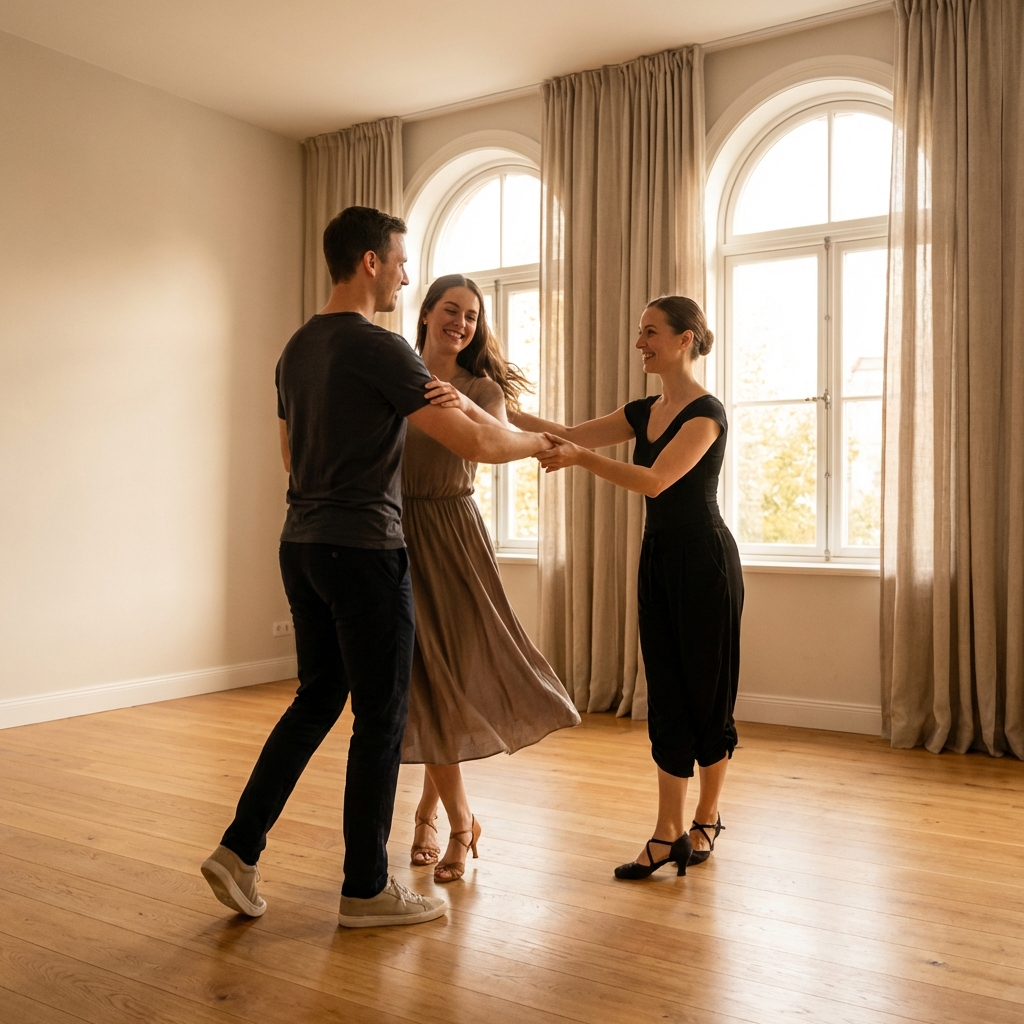
Custom choreography for social dancing: look natural, not rehearsed
Learned the moves and still look stiff on the social floor? You don't need more moves. You need a few that are yours, each with a way out.
Quick answer
Custom choreography for social dancing is a short set of combinations built on your body and your music. Each one is about 8 counts long, with a way back to your basic step. You lead it from the music and your partner, not from memory, so you can start, stop or swap it on any phrase. That is why it looks natural.
In this guide
- Why learned moves look rehearsed at a social
- What custom choreography for social dancing is
- How to build your set, step by step
- How moves become instinct
- Dance as conversation
- Practice drills that loosen you up
- Got a wedding routine? The same rules help
- The test
- Build your set in private, then take it out dancing
- Questions about choreography on the social floor
You practised the combination at home until it was perfect. Then the song at the social was faster than your playlist, your partner turned the wrong way on count 3, and the whole thing fell apart. Now you're wondering if you're the stiff one.
You're not. A sequence that only works when everything goes to plan will look rehearsed, because it is. The fix is to build your moves so every one of them can be dropped. Social dancers aren't performing choreography. They're having a conversation. Still deciding whether to learn routines or improvise at all? Start with social dancing vs. choreography. This page is for when you already have moves and want them to look like yours.
Why learned moves look rehearsed at a social
Moves are taught in sequences: this one, then this one, then that one. That's how you learn a skill. The trouble starts when you dance the sequence instead of the song. You dance from memory instead of in the moment, and it shows:
- You look down at your feet or off into space
- Your movements feel planned rather than spontaneous
- You freeze when something doesn't go as expected
- You do the same sequence with every partner
- You look like you're thinking, not feeling
None of that means you learned the wrong moves. It means they were built for one song and one partner.
What custom choreography for social dancing is
"Custom" means built for you: on your music, your style and what your body already does well. "Social" means it has to work with a partner who has never seen it, to a song you didn't pick. So you build a small toolkit:
- A home base: the basic step you can return to on any 1
- Three to five short combinations, each about 8 counts, that you can lead without a script
- An exit for each one: if a signal gets missed or the music changes, you're back in your basic by the next phrase
- One or two moments for the music: a pause on a break, a slower turn on a soft section
A wedding routine is the opposite: set to one song, danced with one partner, the same every time. Both are useful. They solve different problems.
How to build your set, step by step
- Start from your basic. Pick the step you can do while chatting. Every combination leaves from it and comes back to it.
- Build in 8-count blocks. Salsa and bachata music is phrased in eights, so a block that fits one phrase can start on any phrase. A 32-count chain needs everything to go right for 32 counts.
- Give every block an exit. Before you add a combination, find the count where you can drop it and step back into your basic without a stumble. No exit, not ready for a social.
- Make it leadable, not memorized. Your partner doesn't know your set. Each move needs a clear signal in your hand or frame before it starts. If it only works with someone who rehearsed it, it's a routine.
- Test it on songs you don't know. Dance it to faster and slower tracks in the same style. Change the song, not the dance.
- Hand it to someone new. Dance it with a partner who has never seen it. Wherever it breaks is what you fix next.
How moves become instinct
Choreography isn't the enemy. The goal is to know your moves so well they stop needing thought. That happens in four stages:
- Learn it. You learn a cross-body lead with an inside turn and think about every step. That's normal.
- Drill it until it's automatic. You can do it without counting. Now it's part of your vocabulary.
- Mix it up. Different orders, different music, different partners. This stage takes deliberate practice, and it's the one the six steps above are for.
- Let it go. You hear the music, feel your partner, and your body picks the move.
Dance as conversation
Good social dancers treat every dance like a talk with someone new. No script. They listen, respond and adapt. In practice:
- Connection first: before any move, settle into the hold and a few basics together
- Match their energy: a timid partner needs gentle leading; a confident partner can take more complex patterns
- Answer, don't recite: use your set to respond to the music as it happens
- Miss gracefully: if something doesn't work, smile and go back to your basic. Nobody died
- End with connection: eye contact and a thank-you beat a big finish
Practice drills that loosen you up
1. Dance with your eyes closed.
At home, put on music and dance alone with your eyes closed. No partner, no mirror. It makes you feel the music instead of watching yourself. More ideas in how to practise dance at home.
2. Dance only your set for a month.
Make those few moves smooth, connected and musical before you add more. Depth beats breadth.
3. Change the song, not the style.
Practise your salsa set to salsa songs you've never heard, slow and fast. It breaks the link between one move and one track.
4. Watch your partner, not your next move.
Swap "What do I do next?" for "How does my partner feel? What are they ready for?"
5. Make the basic beautiful.
A smooth basic beats a sloppy combination, every time you dance.
Got a wedding routine? The same rules help
A first dance is real choreography, and it can still look relaxed. Build a home base into it, a sway or basic you can fall back on if you lose your place, so a missed count looks like a choice. Look at each other, not the floor. Torn between a planned routine and a slow dance? Read traditional vs. choreographed first dances, or see how our wedding dance lessons set every count to your song.
The test
Want to know if your dancing looks natural? Dance with someone who has never taken a lesson. Can you make them look good? Can you make them feel comfortable? A leader with a real set can put a beginner at ease from the first basic, because nothing they do depends on a script.
Build your set in private, then take it out dancing
A group class teaches everyone the same combination. In private lessons, Alina builds yours: on your music, your style and what your body already does well, with an exit in every block. She teaches every lesson herself, in English, French or Russian, and brings a two-time Canadian vice-champion's eye to the small things that make a move look stiff. Salsa, bachata or any of her nine styles.
Want partners to test it on? Our group classes rotate partners.
Call 514-966-3736 for a free 15-minute phone consultation. Tell us your style and where your moves feel stiff, and we'll plan your first lesson together.
Questions about choreography on the social floor
Can a follower have custom choreography for social dancing?
Yes, as styling rather than patterns: an arm line, a clean finish to a turn, a hip accent on a break in bachata. Place it where the lead leaves space, in the basic or on a pause, and let it go the moment a new signal comes.
Will my partner need to know my combinations?
No. Every block is led, so a partner who has never seen it can still follow it. If a move only works with someone who learned it with you, keep it for a performance.
How many combinations should my set have?
Start with three you can lead cleanly from your basic. Add another when those three hold up with a new partner, a faster song and a missed signal.
Alina, Founder of Quartier Latin Dance Studio