Quick answer
How do you slow dance? Stand close, take a simple hold, and shift your weight from one foot to the other on every beat, with small side steps. Let the sway curve so you turn slowly as a couple. That one move fills any slow song at a wedding or a party. Add one turn near the end if you want a moment.
I've taught couples in Montreal since 2007, and the slow dance is the move people fear most and need least practice for. You don't need steps. You need a hold that feels good, a sway that matches the music and a plan for three minutes. Here are all three, for whoever leads and whoever follows.
Where do your hands go?
Pick the hold that fits the moment. Both are correct.
The classic hold (weddings, photos, first dances)
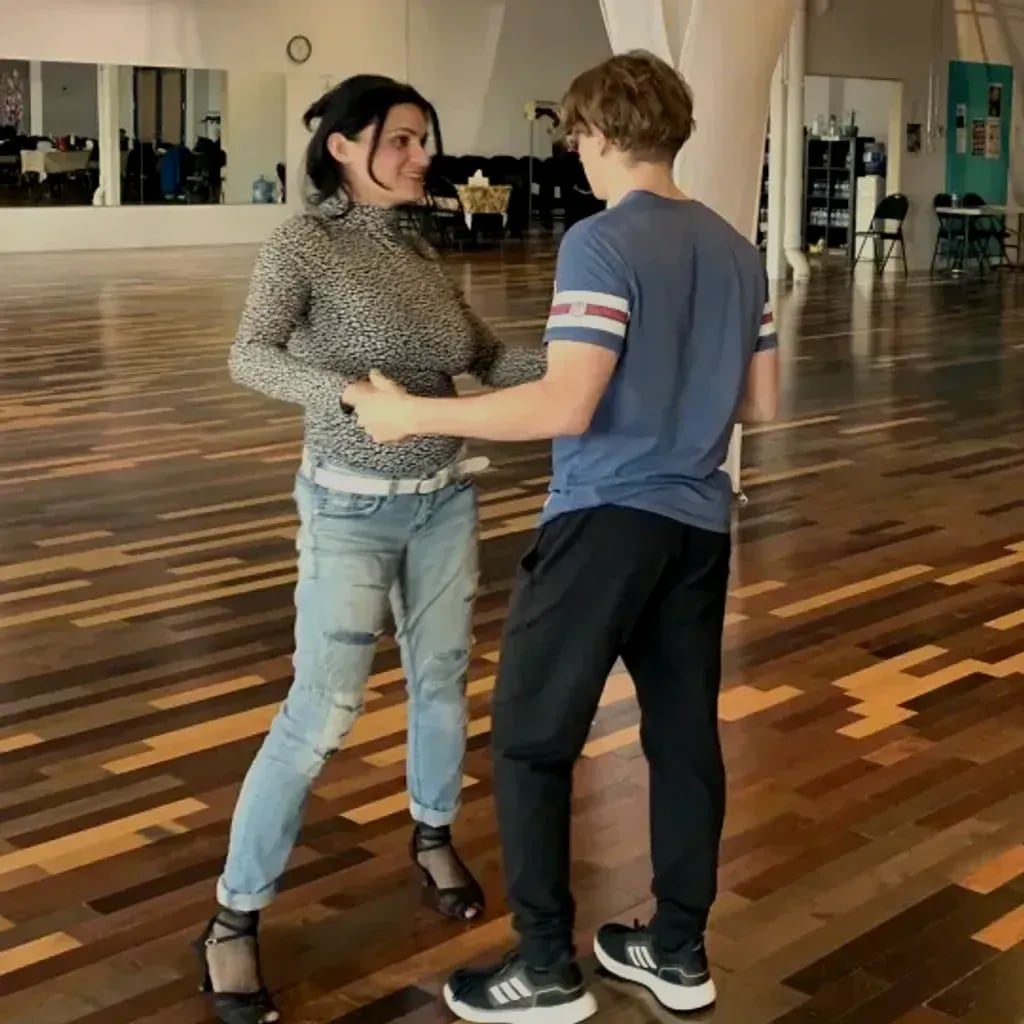
- The leader: right hand on your partner's upper back, just below the shoulder blade. Left hand holds your partner's right hand at about shoulder height, elbow soft.
- The follower: left hand rests on the leader's shoulder or upper arm. Right hand sits in the leader's left, light, not gripping.
- The space: a hand's width between you. Close enough to feel each other move, far enough to see your feet are safe.
The relaxed hold (parties, late night, your own living room)
- One partner's hands on the other's waist, the other's hands on their shoulders or loosely around the neck.
- Closer and easier, but harder to turn from. Great for swaying, not for a big moment.
The rule for both: hands rest, they don't squeeze. A tense hold is the first thing your partner feels.
The basic step: sway on every beat
This is the whole slow dance. Learn it once and it works for every slow song you will ever hear.
- Listen before you move. Let the first few seconds play. Find the steady pulse, the one your head nods to on its own.
- Shift your weight, not your feet. On one beat, press into the left foot. On the next, press into the right. Your body rocks gently side to side.
- Add the step-touch. Step a little to the left, bring the right foot in beside it. Step right, bring the left foot in. One step per beat.
- Curve it. Let each side step drift a little forward on one side, so the two of you rotate slowly. A full circle every 8 to 16 beats looks calm and romantic.
Keep the steps no wider than your shoulders. Small steps look elegant. Big steps find toes.
Leading and following without counting
Counting "1, 2, 1, 2" under your breath turns the dance into a math test. Here is what replaces it.
- Leading: move your chest first and your feet second. When your upper body shifts left, your partner feels it through the hold a moment before you step. That is the lead. No pushing, no pulling.
- Following: keep a little gentle tone in your arms, so you can feel the shift. Wait for it, then match it. You're not guessing; you're listening.
- Either role: soft knees. Locked knees make you bob like a cork. Soft knees make the sway smooth.
Lead and follow is a conversation, not a rule about who's in charge. More on how it works in how leading and following work.
What to do for a whole 3-minute song
Three minutes of the same sway can feel long. Split the song into parts and you always know what comes next.
- First verse: sway in place. Settle the hold, find the beat, smile.
- First chorus: start the slow turn as a couple.
- Second verse: come closer or talk a little. This is the part people remember.
- Last chorus: one underarm turn. The leader raises the joined hands, the follower walks around under them, back to the hold.
- Last notes: slow down with the music and finish facing each other.
Tip: skip the dip unless you've practised it. On a crowded floor, a dip is how backs get pulled and dresses get stepped on. Save it for after a lesson.
If your partner can't dance (or you can't)
One of you knows the sway, the other freezes. Very normal. The one who feels calmer leads, whatever the usual roles. Keep the steps tiny, smile, and talk. Nobody can see small feet in a crowd. If one of you loves to dance and the other doesn't, read couples dance lessons when one partner can't dance.
Getting ready as a wedding guest, groom or groomsman? How to dance at a wedding as a guy adds a fast-song move and a two-week practice plan.
From a slow dance to a real first dance
The sway gets you through any slow song. For your own first dance, with every guest watching and the phones out, most couples want something that feels like theirs: a better hold, a turn that lands on the music, an entrance and an ending. That's the part we build in private lessons.
Our wedding first dance lessons are built around your song and your level, and I teach every one myself (two-time Canadian vice-champion). Still choosing the song or the style? Start with the wedding first dance guide. For a party, a gala or just for fun, private dance lessons work the same way, in English, French or Russian, with free parking in Ahuntsic.
Slow dance questions
How do you slow dance with a guy?
Rest your left hand on his shoulder or upper arm and your right hand in his left, or put both hands on his shoulders for a relaxed hold. Let him start the sway, match his weight changes and keep your steps small.
Do you have to count to slow dance?
No. Feel the beat in your knees, change weight once per beat and follow the music's pulse. Counting out loud makes you stiff; listening to the song works better.
How long does it take to learn to slow dance?
The sway takes one song to learn. Leading a turn and filling a whole song with confidence is what a private lesson is for.
Book a free 15-minute call and tell us your date and your song. We'll tell you how much practice you really need.
Alina Litvak, Founder of Dance Studio "Quartier Latin"
Two-time Canadian Vice-Champion • 19 Years Teaching Experience